


Photo's and images courtesy of "Google Images".
by Felicity Blaze Noodleman
Going through Google Images trying to find a good photo of
the Democratic convention for this article on day two of the coverage in
Charlotte, N. Carolina I am finding so many pic.’s of Bill Clinton. Is he running again? I’m starting to think X Presidents should be
seen and not heard! Where is the Obama
coverage? Well maybe I’ll find something
tomorrow.

From the Convention floor.
When I was watching television the other night I saw a
campaign ad to reelect President Obama only the president was not pictured
speaking; it was President Bill Clinton.
Hey wait; Is this 1992
again? President Obama seems to need a surrogate
or handler to speak on his behalf to get reelected? If only he had done a better job, he could
have run as his own man. Oh please; no
more Bill Clinton!
President Clinton makes the pitch, “We need to keep going
with President Obama’s economic plan”.
Well if the Obama plan was working wouldn’t we know it without being
told that it was working? Also; this ad
asks us to assume that Clinton was a great President, but in reality he was the
second President to ever be impeached by Congress and there were a few other
problems with the Clinton Presidency.
Problems such as allowing issues in the Middle East to go
unchecked. Attacks on US embassy’s and
military installations such as the USS Cole which were not addressed. Below is an article from "Forbes" on the Clinton Taxes:
The Dangerous Myth
About The Bill Clinton Tax Increase
by Charles Kadlec, Contributor
I cover economic/political issues with liberty as my polar star.
"The real lesson of the Clinton Presidency is the way back to prosperity lies not through increased taxes on “the rich,” but through tax and regulatory reform and a return to a rules based monetary policy that produces a strong and stable dollar".
One of the most dangerous myths that has infected the current debate over
the direction of tax policy is the oft repeated claim that the tax increases
under President Bill Clinton led to the boom of
the 1990s. In their Wall
Street Journal Op-Ed last Friday, for example,
Clinton campaign manager James Carville and Democratic pollster and Clinton
advisor Stanley Greenberg write the increase in the top tax rate to 39.6%
“produced the one period of shared prosperity in this past era (since 1980).”
While this myth is now a central part of liberal Democratic folklore, it is
contradicted by the political disaster and poor economic results that followed
the tax increase. The real lesson of the Clinton Presidency is the way back to
prosperity lies not through increased taxes on “the rich,” but through tax and
regulatory reform and a return to a rules based monetary policy that produces a
strong and stable dollar.
The 1993 Clinton tax increase raised the top two income tax rates to 36% and
39.6%, with the top rate hitting joint returns with incomes above $250,000
($400,000 in 2012 dollars). In addition, it removed the cap on the 2.9%
Medicare payroll tax, raised the corporate tax rate to 35% from 34%, increased
the taxable portion of Social Security benefits, and imposed a 4.3 cent per
gallon increase in transportation fuel taxes.
If these tax increases were good for the middle class, then they should have
been popular. Yet, in the 1994 elections, the Democratic Party suffered
historic losses. Even though Senate Majority Leader George Mitchell
had declared the unpopular HillaryCare dead in September of that year, the
Republican Party gained 54 seats in the House and 8 seats in the Senate to win
control of both the House and the Senate for the first time since 1952.
Second, Messrs. Carville and Greenberg are contradicted by their former
boss. Speaking at a fund raiser in 1995, President Clinton said:
”Probably there are people in this room still mad at me at that budget because
you think I raised your taxes too much. It might surprise you to know that I
think I raised them too much, too.”
During the first four years of his Presidency, real GDP growth average 3.2%,
respectable relative to today’s economy, but disappointing coming as it did
following just one year of recovery from the 1991 recession, the end of the
Cold War and the reduction in consumer price inflation below 3% for the first
time (with the single exception of 1986) since 1965.
For example, it was a half a percentage point slower than under Reagan
during the four years following the first year of the recovery from the 1982
recession.
Employment growth was a respectable 2 million a year. But real hourly wages
continued to stagnate, rising only 2 cents to 7.43 an hour in 1996 from $7.41
in 1992. No real gains for the middle class there.
Federal government receipts increased an average of $90 billion a year while
the annual increase in federal spending was constrained to $45 billion. That
led to a $183 billion, four-year reduction in the budget deficit to $107
billion in 1996.
However, with his masterful 1995 flip-flop on taxes, President Clinton took
the first step toward a successful campaign for re-election and a shift in
policy that produced the economic boom that occurred during his second term.
- Welfare reform, which he
signed in the summer of 1996, led to a massive reduction in the effective
tax rates on the poor by ameliorating the rapid phase out of benefits
associated with going to work.
- The phased reduction in
tariff and non-tariff barriers between the U.S., Mexico and Canada under
the North American Free Trade Agreement continued, leading to increased
trade.
- In 1997, Clinton signed a
reduction in the (audible liberal gasp) capital gains tax rate to 20% from
28%.
- The 1997 tax cuts also
included a phased in increase in the death tax exemption to $1 million
from $600,000, and established Roth IRAs and increased the limits for
deductible IRAs.
- Annual growth in federal
spending was kept to below 3%, or $57 billion.
- The Clinton Administration
also maintained its policy of a strong and stable dollar. Over his entire
second term, consumer price inflation averaged only 2.4% a year.
The boom was on. Between the end of 1996 and the end of 2000:
- Economic growth accelerated a full percentage point to 4.2% a year.
- Employment growth nudged higher, to 2.1 million jobs per year as the unemployment rate fell to 4.0% from 5.4%.
- As the tax rate on capital gains came down, real wages made their biggest advance since the implementation of the Reagan tax rate reductions in the mid 1980s. Real average hourly earnings were (in 1982 dollars) $7.43 in 1996, $7.55 in 1997, $7.75 in 1998, $7.86 in 1999, and $7.89 in 2000.
- Millions of Americans shared in the prosperity as the value of their 401(k)s climbed along with the stock market, which saw the price of the S&P 500 index rise 78%.
- Revenue growth accelerated an astounding 59%, increasing on average $143 billion a year. Combined with continued restraint on government spending, that produced a $198 billion budget surplus in 2000.
Shared prosperity indeed! But one created not by raising tax rates on high income but not yet rich middle class families, and certainly not by raising the capital gains tax rate or by imposing the equivalent of the Buffett rule, a new alternative minimum tax of 30% on incomes over $1 million, nor by massively increasing federal spending.
Rather, it was a prosperity produced by freeing America’s poor from a punitive welfare system, lowering tariffs, reducing tax rates on the creators of wealth, limiting the growth of federal government expenditures, and providing a strong and stable dollar to businesses and families in America and throughout the world.
A shared prosperity can be achieved again. But to do so, the American people will have to overcome the envy feeding myth perpetrated by President Barack Obama and the spin-masters and leadership of the Democratic Party that raising tax rates on high incomes will somehow lead to more job creation, more opportunity and increased prosperity and security for the middle-class.
Forbes
Another big issue In the Clinton ad was the “regulation”
statement. Government regulation and
taxes have run so much industry out of this country. I remember writing to President Clinton about
the country loosing so many jobs and how it was going to adversely affect the
nation and how it would create a huge tax deficit not to mention all the pay
checks for American workers. I really
believe that Democrats just don’t care about Americans!
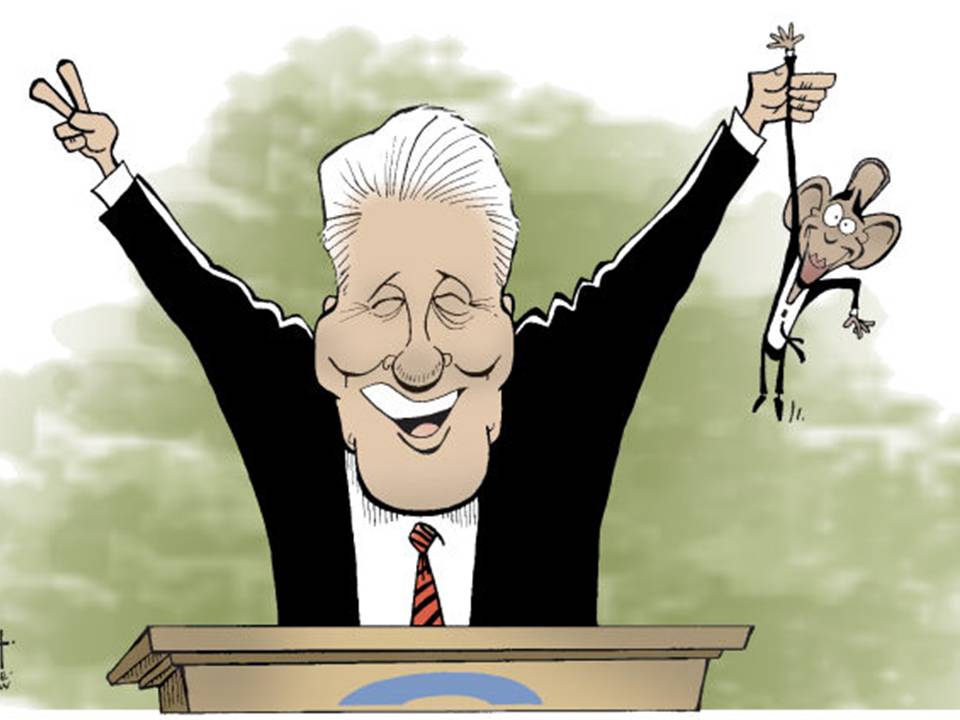
Hey; I've been Impeached for perjury and after all - two liars are better than one!

There used to be a thriving electronics and home appliance
which built everything from televisions to blenders in our country. There used to be a thriving steel industry in
this country to supply automobiles manufactures and all the other industry in
this country. NOW WE ARE THE LARGEST DEBTOR NATION IN THE WORLD!
General Motors has cut three major brands from their
company, Pontiac, Oldsmobile and Saturn.
Buicks and Chevrolets are now built in China because regulation and
taxes have made it cheaper. We used to
have a fourth automobile company in the United States known as “American
Motors” which was driven out of business in the 1970’s by government regulation
and taxes. All of this has happened
because of government regulation and taxation under the Democrats. These were all good paying American jobs with
benefit packages that have been driven out of the country by the Democrats with
their regulations and taxes.

The "Presidential Approval Tracker" from "USA Today". See how the
President is below the 50% rating for a large part of his first term.
Regulation and taxes have made it cheaper for foreign
competition to flood the US market with cheap foreign products which do not
have any government regulation nor do these companies pay the same employee
wages and benefits which the American workers fought for over decades of
collective bargaining.
The Democrats have destroyed American industry. This last decade the Democrats have severely
crippled American housing values buy forcing home lenders to make loans to
buyers who could not qualify for home loans.
As we all know this led to the so called collapse of the housing bubble. If you have ever lost a job due to a factory
closing, company moving overseas, lost a home or had your home value toppled,
the Democrats are the most likely for the blame. Their house of cards has completely fallen
down.

World socialism, the Russians and European Socialists must be
so proud of the American Democratic party!
so proud of the American Democratic party!
So what is it with the Democrats? What are they going to destroy next? If we have to hear anything from the X
President, could he please explain how
he, Ted Kennedy, Barny Frank, Chris Dodd, Barrack Obama, Joe Biden and the rest of
the Democrats got it so wrong and brought down the whole economy by selling
houses to people who could not afford them!
Finally; what have
the Democrats been doing for Sr.’s lately?
Have they completely forgotten about Social Security and Medicare? It would appear so. Under a Congress with Democrats in charge
they have denied Sr.’s their cost of living increases twice. Oh yea, and there is the $716 Billion
President Obama is trying to take from Medicare to fund his “Obama Care” health
coverage.
The Noodleman Group has put together some headlines from the convention with their respective contributors from the convention below:
But if you want a quick review, we've compiled five things that struck us about the night:
video comment on government
The Noodleman Group has put together some headlines from the convention with their respective contributors from the convention below:
Five Takeaways From The Last Night
Of The Democratic
Convention
But if you want a quick review, we've compiled five things that struck us about the night:
Times Have Changed, Obama Has
Changed, Hope Has Changed: The
Obama we saw on Thursday was a more sober and realistic man than the one we saw
in 2008, or for that matter than the one we saw in 2004, when he delivered a
lyrical ode to American unity.
The Obama we saw today didn't run from the promises of hope and change
central to his previous campaign. But he presented a tempered, more serious
version of it, one seen through the prism of a man at the tail end of his first
term as president. In fact, Obama hardly smiled. He said:
"I
recognize that times have changed since I first spoke to this convention. The times
have changed — and so have I.
"I'm no
longer just a candidate. I'm the President. I know what it means to send young
Americans into battle, for I have held in my arms the mothers and fathers of
those who didn't return. I've shared the pain of families who've lost their
homes, and the frustration of workers who've lost their jobs. If the critics
are right that I've made all my decisions based on polls, then I must not be
very good at reading them. And while I'm proud of what we've achieved together,
I'm far more mindful of my own failings, knowing exactly what Lincoln meant
when he said, 'I have been driven to my knees many times by the overwhelming
conviction that I had no place else to go.'
"But as I
stand here tonight, I have never been more hopeful about America. Not because I
think I have all the answers. Not because I'm naïve about the magnitude of our
challenges.
"I'm hopeful because of
you."
This Was An Obama Love Fest: This wasn't a convention for politicians who wanted to talk about their
own accomplishments. In that way, it was very different from the Republican
National Convention. It was a convention that embraced President Obama and his
policies with a great, big bear hug.
Every speaker, every video, every message said the same thing: President
Obama is the man for the job.
Biden Embraced His Tempered Role:
Vice President Biden was given a
less-than-ideal speaking spot in this convention. Normally, the vice president
speaks during prime time, on a different day from the president.
Biden gave up his Wednesday spot in favor of former President Bill
Clinton. And tonight he spoke in the 9 p.m. hour. [Correction at 11:30 a.m., Sept.
7: Earlier, we mistakenly said the
vice president gave up a Thursday speaking slot. It was a Wednesday slot that
he ceded to former President Clinton. We've fixed the mistake.]
The speech he gave was restrained. He certainly sprinkled in some of his
typical humor. But mostly that came when he talked about Mitt Romney. When he
spoke about Obama, he was very serious; he slowed down his cadence and at
times, he almost whispered.
That said, as the man closest to the president's decisions, he served as
a character witness.
"Bravery," he said, "resides in the heart of Barack
Obama."
The Democrats Were Disciplined
With Their Message, Except When They Weren't: This convention was preceded by a big whoops, when Maryland Gov. Martin
O'Malley was asked whether Americans were better off than they were four years
ago. He said,
"No."
But after that the Democrats mostly stayed on message. There was the platform
dust-up. But day after day, speaker after speaker, Democrats
delivered the same talking points about "building the economy from the
middle out and not from the top down." And woman after woman said that
under Obama, "being a woman is no longer a pre-existing condition."
And, Thursday, Sen. John Kerry delivered the answer Democrats most
likely hoped O'Malley had given on Sunday. He said:
"President Obama kept his
promises. He promised to end the war in Iraq — and he has — and our heroes have
come home. He promised to end the war in Afghanistan responsibly — and he is —
and our heroes there are coming home. He promised to focus like a laser on
al-Qaeda — and he has — our forces have eliminated more of its leadership in
the last three years than in all the eight years that came before. And after
more than ten years without justice for thousands of Americans murdered on
9/11, after Mitt Romney said it would be 'naive' to go into Pakistan to pursue
the terrorists, it took President Obama, against the advice of many, to give
that order to finally rid this earth of Osama bin Laden. Ask Osama bin Laden if
he is better off now than he was four years ago."
The Next Big Thing: We're yet to see what the polling repercussions of these back-to-back
conventions will be.
But the next big duel will be mano a mano, when Obama and Romney take
the stage during the three scheduled debates.
Debates were seen as a weak spot for Romney. But during the GOP
primaries, he honed his skills. Still, he spent this week preparing for his
debate against Obama.
The first debate is Oct. 3 at the University of Denver. The second is
Oct. 16 at Hofstra University in Hempstead, N.Y. The third is Oct. 22 at Lynn
University in Boca Raton, Fla.
The vice presidential debate is Oct. 11 at Centre College in Danville,
Ky.
npr
Obama team disavows
video comment on government
By David Jackson USA
TODAY
CHARLOTTE
-- President Obama's campaign is distancing itself from a Democratic convention
video in which a speaker says "government is the only thing that we all
belong to."
Republicans
quickly jumped on the comment, saying it reflects the Democrats' eagerness to
impose government on people's lives.
"We don't
belong to government, the government belongs to us," tweeted GOP
presidential candidate Mitt Romney.
Dan Murrey, the
executive director of the Charlotte in 2012 Host Committee, said in a statement
that it produced the video -- entitled "Welcome to Charlotte" -- that
was designed to promote the city and welcome guests to the convention.
"The
intent of this video was to tell the story of this region and it is completely
unaffiliated with the Obama campaign or the Democratic National Committee,"
Murrey said.
The website Buzzfeed, which cut the
video clip shown above, said it received an e-mail from an Obama for America
campaign official it did not identify:
"The video in question was produced and paid for by the
host committee of the city of Charlotte. It's neither an OFA nor a DNC
(Democratic National Committee) video, despite what the Romney campaign is
claiming. It's time for them to find a new target for their faux outrage."
usa Today
According to Thursday nights speeches by President Obama and Vice President Biden, they are now in the job creation business. "Well isn't that special" is all I can say. Why haven't they been into creating jobs during their first four years in office? Why didn't President Clinton do it during his eight years in office? The Democrats have never to the best of my recollection and everything that I'm able research been in partnership with business or industry. All Democrats have done is hand down more and more regulation which has time and time again run industry out of the country taking American jobs over seas.
Fact checking Obama’s and Biden’s
Charlotte
The Washington Post
I'm Felicity and you've been with the Noodleman Group and as we say in the journalism business, that's -30-.
According to Thursday nights speeches by President Obama and Vice President Biden, they are now in the job creation business. "Well isn't that special" is all I can say. Why haven't they been into creating jobs during their first four years in office? Why didn't President Clinton do it during his eight years in office? The Democrats have never to the best of my recollection and everything that I'm able research been in partnership with business or industry. All Democrats have done is hand down more and more regulation which has time and time again run industry out of the country taking American jobs over seas.
Fact checking Obama’s and Biden’s
speeches at the Democratic convention in
Charlotte
06:02 AM
ET, 09/07/2012TheWashingtonPost
In their defense of the administration’s policies
Thursday night, President Obama and Vice President Biden sometimes took license
with the facts or left out important information. Here are some highlights.
“Independent analysis shows that my plan would cut our
deficits by $4 trillion. Last summer, I worked with Republicans in Congress to
cut $1 trillion in spending.”
— Obama
President Obama repeated a claim made by former
President Bill Clinton the night before, but even less accurately. Clinton
referred to a “plan of $4 trillion in debt reduction over a decade.” Obama
leaves off the time line, and makes it sound like the current $1 trillion
deficit would be eliminated, resulting in a surplus.
But, while the numbers seem large, the
results are unimpressive. At the end of the 10-year budget window, Obama would
have the national debt at a 76.5 percent of gross domestic product. That
actually would be an increase over the 74.2 percent of GDP in this year. In
contrast, the debt reduction plan envisioned by the Simpson-Bowles commission —
cited by the president — would reduce the debt-to-GDP ratio close to 60
percent.
Moreover, independent analysts have criticized the
administration for claiming some $800 billion in phantom savings from winding
down the wars in Iraq and Afghanistan, even though the administration had long
made clear those wars would end. (The Bush administration had started the wars
on borrowed funds.) Then, the president proposes to spend a good chunk of the
nonexistent money on other spending — as he put it in his speech, “rebuilding
roads and bridges; schools and runways.”
The $1 trillion in savings negotiated with
Republicans, mentioned by the president, actually accounts for the bulk of his
proposed reduction in spending. Indeed, much of the president’s debt reduction
would come from tax increases on the wealthy, not spending cuts.
“I’ve signed trade agreements that are helping our companies sell more goods to
millions of new customers."
— Obama
Obama did sign into law new trade agreements with
South Korea, Colombia, and Panama — which were negotiated by the George W. Bush
administration. The trade deals were held up for months by a bitter dispute
between the administration and Congress over restoring aid for workers hurt by
free trade.
Obama has not negotiated any other free-trade
agreements.
“We will keep the promise of Social Security by taking
the responsible steps to strengthen it — not by turning it over to Wall
Street.”
— Obama
This is a bit of straw man. Obama’s rival, Mitt
Romney, briefly supported private accounts as part of Social Security in the
2008 campaign but no longer does.
In his 2010 book, “No Apology,” Romney makes it
clear that the 2008 stock market turmoil had changed his thinking on the issue.
“The 2008 stock market collapse is proof, however, that we can’t always count
on positive returns from these investments,” Romney writes. He said individual
accounts could still be considered but would need to be phased in over time.
Most important, he added, “I would prefer that individual accounts were added
to Social Security, not diverted from it, and that they were voluntary.” (See
page 160.)
In other words, Romney has concluded that
mandatory private accounts won’t work. The plan he supports now is strikingly
similar to what then-Vice President Al Gore proposed in the 2000 presidential
campaign, what Gore dubbed “Social Security Plus.” Gore said the accounts would
be voluntary and “not be the product of any reduction or diversion of Social
Security revenues.”
Meanwhile, Obama’s recent budgets have had limited
Social Security reforms.
“Barack, as a young man, they had to sit at the end of his mother’s hospital
bed, and watch her fight with their insurance company at the very same time
that she was fighting for her life.”
— Biden
This is a carefully worded statement that suggests
President Obama’s mother, Stanley Ann Dunham, was fighting for health coverage
while she was dying. This is a story that Obama frequently told on the campaign
trail, but which was later called into question by Dunham’s biographer. Note
that Biden does not specify that Dunham was fighting “health insurance”
companies.
During the 2008 campaign, Obama frequently
suggested his mother had to fight with her health-insurance company for
treatment of her cancer because it considered her disease to be a pre-existing
condition.
In one of the presidential debates with GOP rival
John McCain, Obama said: “For my mother to die of cancer at the age of 53 and
have to spend the last months of her life in the hospital room arguing with
insurance companies because they’re saying that this may be a pre-existing
condition and they don’t have to pay her treatment, there’s something
fundamentally wrong about that.”
But then earlier this year, journalist Janny Scott
cast serious doubt on this version of events in her biography, “A Singular
Woman: The Untold Story of Barack Obama’s mother.” Scott reviewed letters from
Dunham to the CIGNA insurance company, and revealed the dispute was over
disability coverage, not health insurance coverage. (See pages 335-339).
Disability coverage will help replace wages lost
to an illness. (Dunham received a base pay of $82,500, plus a housing allowance
and a car, to work in Indonesia for Development Alternatives Inc. of Bethesda.)
But that is different than health insurance coverage denied because of a
pre-existing condition, which was a major part of the president’s health care
law.
Biden’s remarks were echoed in the film that aired
before Obama spoke. The clips were drawn from a film originally narrated by Tom
Hanks — this one was by George Clooney — and we had previously given Three
Pinocchios to the film for the manipulative way this story is retold.
“He [Romney] was willing to let Detroit go bankrupt.”
— Biden
This statement is drawn from a headline — “Let
Detroit Go Bankrupt” — on an opinion article written by Romney for The New York
Times. But he did not say that in the article. (He repeated the line, however,
on television.)
Although “bankrupt” often conjures up images of
liquidation, Romney called for a “managed bankruptcy.” This is a process in
which the company uses the bankruptcy code to discharge its debts, but emerges
from the process a leaner, less leveraged company.
Ultimately, along with getting nearly $80 billion
in loans and other assistance from the Bush and Obama administrations, GM and
Chrysler did go through a managed bankruptcy. But many independent analysts
have concluded that taking the approach recommended by Romney would not have
worked in 2008, simply because the credit markets were so frozen that a
bankruptcy was not a viable option at the time.
“What they didn’t tell you is what they’re [the Romney
campaign] proposing would cause Medicare to go bankrupt by 2016.”
— Biden
It is highly misleading to use the phrase
“bankrupt.”
There are different parts of Medicare, much of
which is paid from general revenues and premiums. Part A, which pays hospitals,
has a “trust fund,” made up of special-issue Treasury bonds, that always seems
to be on the edge of running dry, even though it is funded by a payroll tax
paid by employees and employers. But even so, the payroll tax could pay most
estimated expenditures for decades.
“As a matter of fact, he has a new tax proposal — the
territorial tax — that experts say will create 800,000 jobs, all of them
overseas.”
— Biden
Biden is quoting from one disputed study.
At issue is a Romney proposal, as part of a
corporate tax reform, to allow foreign profits by corporations to be exempt
from domestic tax. The Simpson-Bowles deficit-reduction Commission, frequently
cited by Democrats and Republicans, recommended such a system in its report. “A
territorial tax system should be adopted to help put the U.S. system in line
with other countries, leveling the playing field,” the report said.
The study cited by Biden, which appeared in Tax
Notes, did not actually study Romney’s plan. Moreover, it said that such a
system would create 800,000 jobs overseas, but not necessarily at the expense
of U.S. jobs if unemployment rates are low.
“Governor Romney believes that it’s okay to raise taxes
on the middle class by $2,000 in order to pay for over a trillion dollars in
tax cuts for the very wealthy.”
— Biden
The vice president is referring to an estimate of
the impact of Romney’s tax plan by the nonpartisan Tax Policy Center. Romney
has provided few details of his plan, which he says would lower tax rates while
eliminating tax loopholes. The Tax Policy Center calculated that the only way
to make the plan revenue neutral would be to eliminate tax preferences that
also benefit the middle class, but the Romney campaign has fiercely disputed
its findings.
Romney has insisted he would not allow a tax increase
on the middle class, so if the findings are correct, he would have to scale
back his plan to make the math work.The Washington Post
I'm Felicity and you've been with the Noodleman Group and as we say in the journalism business, that's -30-.

My nose isn't getting any longer.

* “The Noodleman Group” is pleased to announce that we are now carrying a link to the “USA Today” news site. We installed the “widget/gadget” August 20, and it will be carried as a regular feature on our site. Now you can read“Noodleman” and then check in to “USA Today” for all the up to date News, Weather, Sports and more! Just scroll all the way down to the bottom of our site and hit the “USA Today” hyperlinks. Enjoy!

The Noodleman Group is on Google Blogger!


