Translate

Friday, July 25, 2014

HISTORIC LOS ANGELES 39,055


HISTORIC

LOS  ANGELES

(ca. 1890) - The Los Angeles Plaza, around 1890. The one story building on the left is the former residence of Don Augustin Olvera. The large two story on the right is the former residence of Don Vicente Lugo. The LA City Water Company building is at the northwest corner of Marchessault and North Alameda (at the center of the photo). (ca. 1892) - Aerial view of the Los Angeles Plaza, circa 1892. The adobe to the left is the former residence and occasional courtroom of Judge Augustin Olvera. 

The large two-story building on the right is the former residence of Don Vicente Lugo and the first home of St. Vincent's College. The Los Angeles City Water Company has a painted sign, and is visible on the northwest corner of Marchessault and North Alameda Street. El Pueblo: The 1781 birthplace of the City, El Pueblo de Los Angeles is today a 44-acre historic park. Originally a small community near the Los Angeles River centered around a central plaza – La Plaza de Los Angeles – El Pueblo is home to La Placita Catholic Church, Olvera Street, the Chinese American Museum, and other landmarks. The State began buying property at El Pueblo in 1953, but abandoned the project in 1990. The 1982 General Plan for El Pueblo has yet to be carried out.
http://www.cityprojectca.org/ourwork/heritageparkscape.html


* Special thanks to "Google Images", "Water and Power Associates", "USC Degital Archives", "New York Times Photo Archive", "The Los Angeles Times", 
and "KCET.org" among others!


BLOG  POST
by Felicity Blaze Noodleman
Los Angeles, CA
7.25.14


The inspiration for this weeks article literally came from Los Angeles rich history itself.  Now how can that be you may ask yourself?  All of today's photographs were made years ago; in some cases, well over 100 years ago!    Most of the scenery has long since disappeared with only a hint here and there of what the area must have looked like before today.  You see, while much of the country was only emerging to become the America of the Twentieth Century, Los Angeles was already there and setting the example for what a modern metropolis should be.

The gilded age was in full swing and would be soon become the art deco styling of the Twentieth Century.  We are captivated by the transformation taking place.  The photographs left behind tell the story of what was here before.  What life must have been like for those Angeleno's who lived here.  These are only a few of at least hundreds, maybe thousands to survive as memento's for posterity.


Los Angeles, at night, 1920. 518 S. Broadway
Opened: July 30, 1914. The L.A. Times reported that over $10,000 had been spent preparing Quinn's Superba. Seating: 700 is one figure. Moving Picture World before the opening in 1914 gave capacity as 900.
Quinn’s Superba Theatre was located on the site where the Roxie Theatre is today on S. Broadway in downtown Los Angeles.
Quinn’s Superba Theatre was next to the Cameo Theatre (formerly Clune’s Broadway Theatre) and the Pantages Theatre (later Arcade Theatre).
Date 1920 SourceThe New York Times photo archive, via their online store, hereAuthorUnderwood & UnderwoodPermission
(
Reusing this file)Public Domain
http://commons.wikimedia.org/wiki/File:Los_Angeles,_1920.JPG#file


(ca. 1915) - Exterior view of the front of Quinn's Superba Theatre, with a view down the street where signs can be seen for the Pantages Vaudeville.  
Historical Notes
Quinn’s Superba Theatre was located on the site where the Roxie Theatre is today on Broadway in Downtown Los Angeles. It was next to the Cameo and the Pantages.
http://waterandpower.org/museum/Early_LA_Buildings%20(1900%20-%201925)_Page_2.html


Looking west on First Street from Main to its corners with Spring, Broadway, and Hill.
http://www.csulb.edu/~odinthor/socal2.html


Gone are the days when derricks might have populated your front yard. First Street, Los Angeles City oil field circa 1900, courtesy of the Seaver Center for Western History Research, Los Angeles Museum of Natural History.
http://la.streetsblog.org/2014/01/14/west-adams-neighbors-come-together-to-oppose-the-drillers-next-door/


We look back at the east face of the south 100s block of Spring. All those wires! The corner of the Bryson Block looms darkly at extreme left.
http://www.csulb.edu/~odinthor/socal3.html

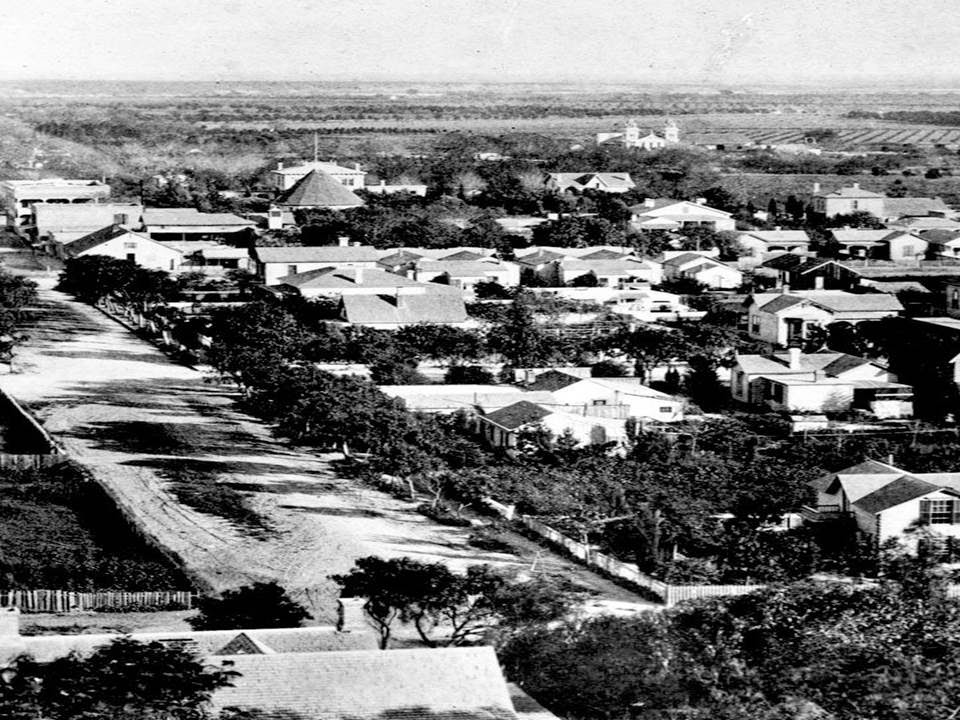
This bucolic scene was Los Angeles in the 1890s, Third Street looking west, past Hill Street. A church on the northeast corner is within walking distance of the residences. That’s the Crocker Mansion at the top of Bunker Hill, a landform that effectively cut off this part of the city from growth to the west.
[Image is from the University of Southern California archives.]
https://www.google.com/search?q=Los+Angeles+houses+-+1900&tbm=isch&ei=crfGU4SNFovioASIvILQAw#facrc=_&imgdii=_&imgrc=IewB2Mx_HJvx0M%253A%3BfSPA8F-Wnhx9WM%3Bhttp%253A%252F%252Fwww.ulwaf.com%252Fimages%252FAngelsFlt3rdSt%252FAngels1898.gif%3Bhttp%253A%252F%252Fwww.ulwaf.com%252FLA-1900s%252FPicturePages%252FAngelsFlight3rdSt.html%3B550%3B266


Looking South East down 3rd Street across Hill Street, 1876

http://www.retronaut.com/2012/04/los-angeles-1860-1886/


MacArthur Park, then named Westlake Park, circa 1892. Courtesy of the Title Insurance and Trust, and C.C. Pierce Photography Collection, USC Libraries.
Park-poor Los Angeles: perhaps it's no surprise that many of the city's earliest parks were born of refuse lands. Flush with public land inherited from California's land grant days, Los Angeles was practically giving away real estate in the latter half of the nineteenth century, donating lots to private individuals or auctioning off tracts to fill the city's coffers. But some lands eluded buyers.
http://www.kcet.org/updaily/socal_focus/history/la-as-subject/when-las-oldest-parks-were-young.html


(ca. 1895) - View of Spring Street looking north from 2nd Street. The courthouse can be seen at upper-center and the Nadeau Hotel in center of photo.  
Historical Notes
The Nadeau Hotel stood on the southeast corner of 1st and Spring Streets until 1932, when it was demolished to make room for the current Los Angeles Times building.
http://waterandpower.org/museum/Early_City_Views%20(1800s)_Page_4.html


(1924) - Hotel Rosslyn and Hart Brothers Rosslyn Hotel Annex, Los Angeles  
Historical Notes
In 1923, as a result of the prosperity enjoyed by the Rosslyn and the surrounding district, the Rosslyn Annex was built across 5th Street, and today is still called the Rosslyn Hotel. The two buildings were connected by an underground marble tunnel, portions of which survive to this day.
Both buildings were designed by architect John Parkinson, who was one of the most prolific architects in Downtown Los Angeles, responsible for much of the area's finest architecture, including Union Station, Bullock's Wilshire, the Title Guarantee Building, the Continental Building, the Alexandria Hotel, the Los Angeles Athletic Club, Security Bank (now the Los Angeles Theatre Center), the Los Angeles Memorial Coliseum, and Los Angeles City Hall.

http://waterandpower.org/museum/Early_LA_Buildings%20(1900%20-%201925)_Page_2.html


(1916) – View of the Merritt Building located at 8th and Broadway in downtown Los Angeles.  
Historical Notes
Hulett C. Merritt, described by the Dec. 11, 1910 Los Angeles Herald as a "millionaire and financier" in an article about the planned Merritt Building in downtown Los Angeles.  At the time, Merritt was pushing city leaders to waive building height restrictions from 180 feet to 233 feet.  Merritt is reported as saying he would scrap plans for the Italian Renaissance-style monument to his family unless he was allowed the height variance, otherwise "its beauty will be marred and I want to build for the artistic value more than for any profit I may get out of it."  Originally from Minnesota, Merritt had sold his interests in the Merritt - Rockefeller syndicate in 1891 for more than $81 million.
When the Merritt Building opened in 1915 it looked quite nice. Merritt’s request to construct a 23-story edifice was turned down by the City Council. He scaled back his plans and ended up with a ten-story design that set a rendition of Minerva's Temple on top of a three-story base.*^#*

http://waterandpower.org/museum/Early_LA_Buildings%20(1900%20-%201925)_Page_2.html


"Engine Company 9 On A Run"
The era of the horses began in 1877 with the purchase of two horses for the volunteer company Hose Company 1 and ended July 19, 1921, when Water Tower 1, (the Gorter Water Tower), assigned to Engine Co. 24, was taken out of service and sent to the shops to be motorized.
http://www.lafire.com/stations/fire_stations.htm


Source: Los Angeles Fireman's Relief Association
Engine Company No. 28

644 South Figueroa Street 

Circa 1913
OpenedJuly 15, 1913Cost of Land $ 37,750.Cost of Building$ 65,110.ArchitectJ. P. Krempel &

W.E. ErkesContractorKuhach & Co.Sq.Ft.  Site 50x156 7,800Sq.Ft.  Main Bld.20,831.

(1913 to 1969)
http://www.lafire.com/stations/FS028/FS028_1913-1969.htm


Several airports around the LA area serviced air transportation – Glendale and Burbank along with Los Angeles Municipal Airport (Mines Field) located southwest of downtown L.A. (ca. 1928)* - Administration building in foreground and hangars in background at Mines Field (later to become the L.A. International Airport)
http://waterandpower.org/museum/Aviation_in_Early_LA_(Page_3).html


SUBTERRANEAN  LOS  ANGELES
Ryan manager of the King Eddy examines of the murals from the basement speakeasy days of the King Eddy. The Eddy was moved beneath the ground floor to the basement. The former saloon was leased out to a piano store. Patrons would knock on the back door of the store, give a password and then enter the 2,000 square foot basement to enjoy a drink in Los Angeles. The King Eddy basement had a 130 foot long tunnel that connected to a network of service and utility shafts across downtown Los Angeles – perfect for deliveries of bootleg liquor. The eleven miles of tunnels were built in 1910 for the hotels in the area to avoid street congestion in downtown's growing business district.

While the rest of the country was forced to go dry, underneath Downtown Los Angeles the party never stopped.  Despite prohibition laws, 11 miles of service tunnels became passageways to basement speakeasies with innocuous fronts above ground. Patrons were able to move about under the city, boozing it up without a care in the world, while the Mayor's office ran the supply of hootch.

King Eddy Saloon, an establishment that has been alive and kicking on 5th and Main since the 1900s, hid in plain sight fronting as a piano store. Luckily, local officials took no issue with King Eddy's sudden interest in music, and the business not only survived, but prospered. Now an official saloon once more, its basement still remains part of the tunnel system, littered with crumbling brick lines and graffiti murals.

Aside from the service tunnels, there are also abandoned subway and equestrian tunnels from the days before personal vehicles began clogging up LA's city streets. There are stories of these tunnels being used by police to transport prisoners, bank security to move large sums of cash safely, and both coroners and mobsters to store bodies. Now they are mostly closed off, but some are still accessible and are used as film locations, easy shortcuts by city employees between buildings, and a place for runners to train on the rare occasion of bad weather.
http://edespeedsmedia.blogspot.com/2013/09/the-king-eddy-saloon-is-located-in-once.html
http://www.atlasobscura.com/places/underground-tunnels-los-angeles


Nov. 30, 1925: An old horse-drawn car makes a trip during grand opening ceremonies for the higher-tech Pacific Electric subway, the city's first subway, which stretched a mile between 1st Street and Glendale Boulevard and Hill Street between 4th and 5th streets. This photo was published in the Dec. 1, 1925, Los Angeles Times.
http://framework.latimes.com/2012/07/05/pacific-electric-subway-opens/#/0


Angelenos practice an air raid drill in the former Pacific Electric subway in 1958.
http://www.atlasobscura.com/places/underground-tunnels-los-angeles


Rare Images Of Los Angeles’ Forgotten Lost Subway By Dorothy Tan, 03 Jan 2013

Los Angeles-based blogger Alissa of Gelatobaby went on a tour of the city’s former subway terminal building and captured these intriguing and little-seen pictures of an abandoned segment of the subway network.

A secret underground world of dark tunnels and vintage signage, the dilapidated condition of the lost subway makes it look like a set out of a horror movie.

After being used as a fallout shelter, the subway tunnel was sealed up in the 1960s—see more rare and haunting beautiful pictures of this forgotten subterranean space below:
http://designtaxi.com/news/355017/Rare-Images-Of-Los-Angeles-Forgotten-Lost-Subway/?interstital_shown=1


 Tell your friends and associates about us! 
It's easy!  Just copy and paste me into your email!


Friday, July 18, 2014

LAPD 38,340


*  All images courtesy of "Google Images".
Information contained in this article courtesy of "Wikipedia,
"The Los Angeles Times" and "89.3 KPCC,Southern California Public Radio"
Titles by FBN.


BLOG  POST
by Felicity Blaze Noodleman
Los Angeles, CA
7.18.14

My Name if Felicity Blaze Noodleman and I write for the Noodleman Group.  This week’s article will address the problems we all are faced with concerning the sky rocketing financial costs of Government at every level and especially the exorbitant costs of law enforcement here in Los Angeles, CA.  

Last week we took a look at "Cops in the News"; this week we want to focus on the LAPD. First of all let me state the need for law enforcement.  It should be responsible law enforcement.  I’m usually one to cry “police brutality”, but every once and a while I run across an incident which leads me to ask myself; what in the world do these guys think they are doing?


Now; before I go any further let me say in all fairness, Los Angeles has some very special law enforcement needs.  LA is a major port area -  a port of entry for all air and sea traffic coming into the United States.  LA is also not that far from the US – Mexico border which presents other security issues.  Lastly; LA is home to the entertainment industry which has its own law enforcement issues.


"The color of authority".


The List of law enforcement in the county of Los Angeles is truly astounding and our tax dollars are paying for it all.  It would seem to me that local law enforcement easily our number the National Guard.   With approximately 20,612  officers working out of an estimated 4 different local law enforcement agencies (LAPD – Los Angeles Police Department;  LASD – Los Angeles Sheriff Department; LAGSP – Los Angeles General Services Police; and the LAXPD – Los Angeles Airport Police Department) it is no exaggeration to say that we are living in a police state similar to Nazi Germany.  Also consider all of the other law enforcement agencies working within the LA area (Highway Patrol, Port Authority, State Police and FBI ect.). 


Each of Los Angeles 42 contract cities also maintain a police force.  The list is truly extensive. These days the trend for law enforcement is growing steadily since 9/11 with more and more safety police, special interest guards and security guards showing up on a yearly basis.  Policing is becoming big business!  Many of these agencies are paying good wages including benefits – you know; the works – health and pension!  When all the expenses are added up including cash settlements for police misconduct it would seem that taxpayers are being held hostage - pay what is being demanded or else! 


2012 has not been a good year for the LAPD as this South LA
accident illustrates.


WHY  AM  I  WRITING
THIS  ARTICLE ?


The other day I was having breakfast and coffee at my regular Jack In The Box.  After using the woman’s room I was stepping out for a cigarette when I noticed 6 or 7 police officers arresting another of the restraints customers whom I will call “Johnny Boy”.  Johnny comes to the Jack In The Box also for breakfast.  He is homeless and a mental case as I have observed him talking to his imaginary nemesis.  Sometimes Johnny can get quite loud and I believe this is why he was being arrested.  Question:  Why so many police officers who all showed up in their 5 police cars just to detain and arrest one mentally disabled homeless man?  I feel this was excessive.


As I go about my daily business moving back and forth in Los Angeles, so many times I observe the police committing a high number of infractions which you or I would be cited for.  Shouldn’t our police be setting a good example for us all?  Of course they should but don't always do so.  I suppose they think their badges grant them extra rights.  Here’s an example of what I’m talking about.  On the very same day I witnessed Johnny Boy being arrested by a brigade of LAPD officers I am going home when I see this LAPD riot vehicle parked in a bus stop zone.  I questioned the officers about it and suggested they move ahead to a more neutral area and park their vehicle which they did.  Sometimes I think the police just aren’t paying attention to what they’re doing at all!


The two above incidents are just a few of so many cases I have witnessed over the years.  Are the police just stressed out and not even thinking at all?  I realize they are only human but give us all a break officers!  You are supposed to be making our streets safer but in some cases the police are the number one hazard.  We need to really "be ware" when these officers who operate under the motto "to protect and serve" are around.


LAPD auto accident in N. Hollywood - 2010, (give yourself a ticket
for that one officer)!


Speaking as one citizen who gets a little upset when she hears about police officers who are involved in any kind of misconduct and the law suits that go along with this kind of lawlessness, I become enraged by the cash settlements the city is obligated to pay out in judgments for irresponsible police officers. 


 LAPD on Hollywood Blvd. 2006 involved with brutality incident.


Are the police as bad or worse than criminals?  City budgets are now operating in the red financially and having to borrow money to meet their annual payrolls. This has been happening for some time now and is expected to continue rising out of control.  Record payouts by Jury awards to victims of police brutality seem to be at an all time high.  This also includes property damage settlements for the irresponsible behavior of our officers in blue.  Credit ratings for all levels of our government have fallen and are approaching the default point.  If you or I had a credit rating this bad we would be cut off and be expected to repair our finances or else!  We cannot afford this kind behavior from our police officials not to mention the stigma it gives society as a whole!


LAPD beating victims top left to right:  Rodney King 1991 - Michelle Jordan 2012
bottom left to right:  Oliver Martinez 2012 - Brian Mulligan 2012


Now we have come to the subject of officer involved shootings.  The numbers are not good for the LAPD.  We have pulled a recent report from the "LA Times" which explains:


Watchdog disputes LAPD rationale for rise in police shootings

A report by the Police Commission inspector general disagrees with LAPD Chief Charlie Beck's assertion of a link between the jump in officer-involved shootings and assaults on officers.

July 02, 2012|By Joel Rubin, Los Angeles Times

Last year, as the number of police shootings soared, Los Angeles Police Chief Charlie Beck repeatedly gave his bosses and the public an explanation: Officers were discharging their weapons more because they were coming under attack more. He bolstered his assertion with LAPD statistics that showed an increase in the number of assaults on officers.

But an independent LAPD watchdog now contends there was no link between the dramatic rise in officer-involved shootings and assaults on officers.

Alex Bustamante, the inspector general for the Los Angeles Police Commission, which oversees the LAPD, scrutinized the 2011 assault and shooting figures in a report he will present to the commission Tuesday. In the report, he challenged the way the LAPD tallies assaults on officers, suggesting it is misleading.

Los Angeles police fired their weapons in 63 incidents last year, a total which marked a roughly 50% increase over the shootings in any of the previous four years, according to the report. Beck has explained the increase by pointing to what the LAPD said was a 22% increase in assaults on officers from 2010 to 2011. Police officials counted 193 such incidents in 2011, which were recorded as assaults with a deadly weapon or attempted murders, according to the report.

"Officer involved shootings are also up — largely in response to these kind of attacks," Beck told the Police Commission in November.

But the inspector general found several reasons why he said this cause-and-effect relationship wasn't accurate. For one, from 2007 to last year, the number of assaults on officers fluctuated dramatically from one year to the next. The number of officer-involved shootings, however, remained relatively flat until last year, when they jumped. If there had been a connection between the two, the year-to-year totals should have climbed and dropped in sync, according to the report.

The way the department tracks shootings and assaults on officers also muddied matters, Bustamante found. Attacks on officers are tallied based on the number of officers present when assaults occur. By contrast, the department counts an officer-involved shooting as a single event regardless of how many officers open fire. In an incident in April 2011, for example, in which a suspect shot at police from inside a house, the LAPD counted 16 assaults on officers and one officer-involved shooting, despite the fact that 15 officers fired their weapons.

When Bustamante recalculated last year's assault total to count the number of incidents instead of officers, he counted 106 attacks — a 45% drop from the department's total. And, instead of a double-digit increase that Beck had contended, Bustamante said the number of assaults was actually about even from 2010 to 2011.

Finally, the report examined the department's Southeast and 77th Street divisions, both of which experienced large increases in officer-involved shootings in 2011. It showed that while attacks on officers rose in 77th Street, they fell in Southeast.
"As such, there does not appear to be a clear correlation" between attacks and shootings, the report concluded. Bustamante's report did not offer any possible explanations for the increase in officer shootings.

The Los Angeles Times


I recently read of a case involving an police shooting of an unarmed 19 year old youth.  Officers discharged 120 rounds killing the suspect.  The youths family is suing  the city of LA for $120 million, a million for each round fired. Do you have $120 million?  I don't!  I couldn't afford the legal costs.  I guess the police were feeling exceptionally wealthy that day and must have thought the city's insurance would take care of the mess.  The story was reported by 89.3 KPCC; Southern California Public Radio and follows below:


Family of Abdul Arian sues city for $120 million — $1 million for every shot fired, they say


County of Los Angeles

A drawing from Abdul Arian's autopsy shows multiple bullet wounds. Arian's family is suing LAPD, claiming they used excessive force when officers shot and killed the 19-year-old.

Abdul Arian was shot and killed by LAPD officers after a freeway chase April 11, 2012. Today, his family announced they're suing the city for $120 million — that's $1 million for every shot they say police fired at the teen.

The family's attorney, Jeffrey Galen, said it was the worst case of excessive force he's seen in his 25-year career, and that more accountability is needed to keep police shootings from escalating.

"It would have been excessive to fire just one shot," Galen said. Meanwhile, he said police and the city have been uncooperative in giving the family information about the night of Arian's death. The lawsuit, he said, is to seek justice and to seek answers.

The incident made national headlines. After a chase, Arian, 19, stopped his car, blocking lanes on the 101. A police car then hit the car's drivers side door, and Arian ran out the other side of the car. Video from a news chopper shows Arian running back and forth across the freeway, sometimes taking an odd stance (which some have described as a "shooting stance"), before he's fatally shot.

Tyler Izen, president of the Los Angeles Police Protective League, has said Arian's actions made police believe their lives were at risk.

Galen said Arian was clearly taking photos with his camera and said that the nearest officer, who he said was maybe 6 feet away, would have been able to see that Arian was holding a cell phone. "With the headlights and the spotlights from the helicopter, it was like daylight," Galen said.


Arian was unarmed, but police have said he called 911 and told dispatch he was carrying a gun and was ready to engage with police. That recording hasn't been released, but police did release a partial transcript of the conversation. In it, Arian is quoted as telling the dispatcher, "I have a gun," and "If they pull their guns, I'm gonna have to pull my gun out on them."

Galen said the phone call lasted nine minutes and if released, could give insight into Arian's state of mind and why he failed to pull over for police cars. Galen said the family has tried to hear the tape on their own, without a public release, and has been repeatedly turned away. Galen said he called the City Attorney's Office to ask why they wouldn't let the family hear the tape or view photos on the cell phone, and was told, "if you want it, subpoena it." That's when the family decided to do just that and file suit, Galen said.

The City Attorney's Office was not immediately available for comment. LAPD spokespeople said they cannot comment on an open lawsuit.

The lawsuit names the City of Los Angeles, the Los Angeles Police Department, Chief Charles Beck, and a number of anonymous police officers. The defendants are expected to be served with papers Monday and then will have 21 days to respond.

On Monday, standing on the steps of the Federal District Court in Downtown Los Angles, they questioned why officers couldn't have used less lethal force to subdue Arian. Galen also questioned why officers, if they were in fear for their lives, "charged" towards Arian instead of taking cover.

Galen said the shooting was also reckless, claiming shots hit nearby buildings, including a Porsche dealership. According to the Coroner's report, Arian was shot in the head, torso, left arm, right hand, right shoulder, right thigh, lower right leg, left wrist, and the leftside lower back. The Medical Examiner found no drugs or alcohol in his system and family said Arian had never suffered from depression.

Family members described Arian as a "good boy." His sister, Nelofar Arian, said her brother always came running when she needed help. She said more than anything, Arian, who drove a Crown Victoria, wanted to be a police officer. His favorite hobby, she said, was "driving his car." She said her mother is so distraught, she "can't talk."

Galen said if they win the suit, the family plans on donating a substantial amount of the money back to the LAPD to invest in officer use-of-force training.

Officer-involved shootings have risen dramatically in Los Angeles lately. In 2011, there were 54 fatal officer-involved shootings, up 70 percent from the prior year.
Around the country, the number of officers killed by suspects has also risen: 72 were killed last year, up 75 percent from 2008.

89.3 KPCC  S.C. Public Radio


IS  IT  TIME
FOR  GOVERNMENT  TO
RETHINK  LAW  ENFORCEMENT?


The basic concept of law enforcement in the United States really hasn’t changed much in the last 150 years.  Do the police really need to be carrying guns?  Most police departments and their officer’s act like they’re Wyatt Earp or something during the days of the wild west in Tombstone, AZ of the 1870’s.  Our police officers are the last of the cowboys!  In today’s world of 2012 shouldn’t we be advancing to the next logical step in law enforcement?  Do our police officers really need to be carrying guns?  A list of countries where the police no not carry guns is as follows:


  • England
  • Wales
  • Scotland
  • Republic of Ireland
  • New Zealand
  • Cook Islands
  • St. Helena - They also police Ascension Island and Tristan Da
  • Falkland Islands
  • Pitcairn Island
  • Iceland


Countries such as Japan and Germany are among other nations which normally don't arm their police offers as well but I do not have a complete list.  These nations are far more advanced than ours in the practice of policing.   I mean honestly;  the days of the gun slinger are over!  I feel a huge financial savings could be realized if local governments would only follow the examples of these more advanced civilizations.  STUDY IT, TEST IT AND IMPLEMENT IT!  What we need today in the 21st. Century is "smart law enforcement".  You would think with everything police officers carry on their belts for eight to twelve hours a day that they themselves would want loose their guns.


Let me offer another cost saving idea concerning our police departments.  Could we implement a program which would be similar to the military?  Officers would serve in a four year program like the National Guard and then be released.  This would save a lot of money since there would be no pensions offered and would continually add fresh young officers  eliminating the problem of stressed older policeman.  Just an idea!  I found a very interesting web site which reports national police statistics and will pass it along to you:


http://www.copblock.org/17484/infographic-a-neutral-look-police-brutality/


I have not enjoyed writing this article at all.  It cuts across my grain but these things have to be exposed.  In conclusion:  now that I've added my two cents worth about the police, that's about what it's worth.  Things probably won't change until there is some kind of monumental incident of catastrophic proportions.  This is Felicity trying to stay out of LAPD's way and hoping for the best! Next week we will take a look at Los Angeles history.  From the 1860's up into the recent past. Some very interesting vintage photos!


 "NO  COMMENT"


 Tell your friends and associates about us! 
It's easy!  Just copy and paste me into your email!


The Noodleman Group is on "Google Blogger"!