Translate

Friday, December 13, 2013

MONEY 19,912


PRODUCING  MONEY


*  Special thanks to "Google Images", (all photos represent a close resemblance of the actual processes involved), "The New Yorker", and the "usmint.com"


BLOG  POST
by Felicity Blaze Noodleman
Los Angeles, CA
12.13.13


Much has been written down through the years about our subject this week, money, as we begin this Friday the thirteenth.  Expressions such as one of the oldest; "The love of money is the root of all evil' (The Bible).  Many other quotes are much harder to trace, such as "Money can't but happiness or love".  "Money talks"!  "A fool and his money are soon parted".  "Money doesn't grow on trees"; the list is almost endless.  Songs have also been written about the stuff! "Money" (That's what I want) (Jr. Walker & the All Stars), Money,Money, Money (Abba), "Money Changes Everything" (Cyndi Lauper) and again the list is too long to continue.  Recording artists have even used money in their last names such as  Eddie Money and Johnny Cash!

Our article this week looks at the United States Treasury Department and will discover the process involved in printing our money and the making of our coins.  Since we are spending so much money at this time of year, did you ever wonder how it’s done?  Before starting this article we had a basic knowledge about the process involved, but we were highly impressed with the latest innovations implemented by the Treasury Department which is using the highest and most sophisticated techniques made possible by the latest state of the art equipment available today.

For the production of US coins, which is the very old trade know as metal fabrication and the printing of the paper notes we use for folding cash; we will explore some of the modern specialized printing equipment, the process for both forms of money is highly labor intensive. Money production involves many steps to create the finished product.  The US Treasury combines both art and technology to produce currency that is very difficult to forge by counterfeiters and helps protect our economy keeping it safe from economic collapse by hostile foreign governments who have tried in the past to flood the economy with unauthorized currency.

Most of this article will be supplied by the Treasury Department which we will supplement with photography found from “Google Images” to illustrate the information.  First however we will begin with an article written in August of this year from the “New Yorker” which reported a $30 Million dollar mistake in the production of the newly designed $100 dollar bill discovered by the Bureau of Engraving and Printing to spark your interest!  This article will give you a glimpse into some of the new security features being incorporated on today's money and how art and technology now meet with the new precautions to safeguard  money and the economy.


"The New Yorker"

A Blunder at the Money Factory

Posted by David Wolman
August 13, 2013


Photograph by Mark Wilson/Getty.
http://www.newyorker.com/online/blogs/newsdesk/2013/08/blunder-at-the-money-factory.html


For the past few years, the Federal Reserve has been preparing to introduce a redesigned hundred-dollar bill into circulation. It will have a Liberty Bell that changes color, a new hidden message on Ben Franklin’s collar, and tiny 3-D images that move when you tilt the bill this way or that. But delay has followed delay. And now again: The New Yorker has learned that another production snafu has taken place at one of the country’s two currency factories, according to a document from the Bureau of Engraving and Printing.

The cause of the latest blunder is something known as “mashing,” according to Darlene Anderson, a spokeswoman for the bureau. When too much ink is applied to the paper, the lines of the artwork aren’t as crisp as they should be, like when a kid tries to carefully color inside the lines—using watercolors and a fat paintbrush.

Anderson said this happens “infrequently.” Still, this foul-up is only the latest embarrassment for the bureau. The redesigned hundred-dollar bill was meant to be released in early 2011, but has been delayed for the past two years because of a massive printing error, separate from the recent mashing problem, in which some notes were left with a blank spot.

This time, recent batches of cash from the Washington, D.C., plant contained “clearly unacceptable” bills intermixed with passable ones, according to a July memo to employees from Larry Felix, the bureau’s director. So the Fed is returning more than thirty million hundred-dollar notes and demanding its money back, Felix wrote. Another thirty billion dollars’ worth of paper sits in limbo awaiting examination, and Fed officials have informed the bureau that they will not accept any hundred-dollar notes made at the Washington, D.C., facility until further notice.

Felix’s letter says internal quality-control measures should have prevented the bureau “from delivering defective work,” and that those responsible would be held accountable. The bureau now has to race to meet an October 8th deadline for delivering the year’s cash orders and to finally get the new hundred-dollar bill into circulation as promised. To that end, Felix has ordered the country’s other money factory, in Fort Worth, Texas, to accelerate its efforts. “There are dire consequences involved here because BEP sells Federal Reserve notes to the Board to finance our entire operation,” he wrote in the memo. “If the BEP does not meet the order, the BEP does not get paid.”

The financial toll from the recent bungle is tough to know: the Treasury and the Fed have little interest in calculating it, let alone being transparent about it. Still, the direct cost probably isn’t greater than the sum of what the bureau pumps out in a few days. “Central banks are a bit like other businesses,” said Ben Mazzotta, a researcher at the Fletcher School’s Institute for Business in the Global Context who focusses on the costs of different forms of money. “They can draw down inventories or order additional product.”

There are other costs, though. Taxpayers will have to pay to inspect, correct, produce, transport, and secure all the additional money that will replace the botched notes. Disposing of the bad bills? That’s on taxpayers, too, as are the additional hours spent making up for the mistake by employees of the bureau.

A possible greater cost of these scrip shenanigans is diminished confidence in the greenback. The situation is akin to a magician getting caught unloading a crate of bunnies from the back of his truck. It threatens to injure the aura—the almightiness—of the dollar that enables most people to go about their business without ever stopping to examine the bills in their hand or to contemplate what gives them value. The only thing conferring value on those dollars, of course, is trust in other people’s trust in them, which is both weird and magnificent.

David Wolman is a contributing editor at Wired. His latest book, “The End of Money: Counterfeiters, Preachers, Techies, Dreamers—and the Coming Cashless Society,” is out this month in paperback.

"The New Yorker"


"usmint.gov"


Photo Walkthrough of U.S. Mint at Philadelphia
by RHONDA KAY on OCTOBER 7, 2013 
http://www.coinnews.net/2013/10/07/photo-walkthrough-of-u-s-mint-at-philadelphia/


THE MINTING PROCESS REVEALED

Here, Earl Sandt, Tool Maker, Digital Process & Development Division, operates the OGP Flash 500 optical microscope to scan tooling dimension information. This data is shared with the S-21 CNC machine (shown further below). Later, a cylindrical grinder is used to automatically shape hubs and three-inch dies.
http://www.coinnews.net/2013/10/07/photo-walkthrough-of-u-s-mint-at-philadelphia/

Step 1: Blanking

All coins start as a sheet of metal.  The United States Mint buys metal strips that are about 13 inches wide and 1,500 feet long.  These strips are wound into giant coils, which are easier to move.
Each coil is fed through a blanking press, which punches out round disks called blanks.  The strip of metal that's left over is called webbing.  It's shredded and recycled—usually into another sheet of metal.
The Mint doesn't make blanks for pennies—it buys them.  However, the Mint supplies fabricators with the copper and zinc that are used to make the penny blanks.


This photo shows how the metal discs look after running through an upsetting mill. They now have edges and are called planchets.
http://www.coinnews.net/2013/10/07/photo-walkthrough-of-u-s-mint-at-philadelphia/


Step 2: Annealing, Washing, and Drying

Because nickels, dimes, quarters, half dollars, and dollars are all different sizes, so are their blanks.  They're even a mix of different metals.  But all blanks need to be prepared before they can be minted.
First, the blanks are heated in an annealing furnace to soften the metal.  Then, they are run through a washer and dryer.  This makes the blanks nice and shiny!

Step 3: Upsetting

It's not the bad blanks but the good ones that are upset.  Why is that?  Because upsetting is the next step in the process.  A machine, called an upsetting mill, raises a rim around the edge of the blank.  If you run your fingers around a coin, you can feel this tiny raised edge!

Step 4: Striking

At this point, the round piece of metal is still a blank.  This makes sense—it doesn't yet have the design and lettering that make it a coin.
The process of adding these items is called striking.  The upset blanks go through the coining press.  All at once, this machine strikes the pictures, amount, and mottoes onto both sides of the blank.  Now it's a genuine United States coin!


A new Perry’s Victory coin is about to drop down a chute and on a tray while, at the same time, a fresh planchet is fed for striking.
http://www.coinnews.net/2013/10/07/photo-walkthrough-of-u-s-mint-at-philadelphia/


Kennedy Half-Dollar Hub (top left) – 
Obverse  Kennedy Half-Dollar Hub (top right) – Reverse
2014 Kennedy Half-Dollar Dies (bottom left) (Top View)
2014 Kennedy Half-Dollar Dies -  Side View (bottom right)
http://www.coinnews.net/2013/10/07/photo-walkthrough-of-u-s-mint-at-philadelphia/


Step 5: Inspecting

Not all coins are ready to circulate.  Some need to be remade.  That's why after they're struck, coins must be inspected before they can leave the Mint.
First, the press operator uses a magnifying glass to spot-check a new batch, making sure that the designs and inscriptions came out right.  Then, the coins are put through a coin sizer.  This machine screens out any misshapen or dented coins.

Step 6: Counting and Bagging

Now the coins are ready to leave the Mint!
First, an automatic counting machine drops coins into large canvas bags.  As it does this, it keeps track of the number of coins it drops.  The bags are sewn shut and loaded onto pallets.  Then forklifts move the pallets to storage vaults.
When a Federal Reserve Bank needs more coins, the Mint ships them in an armored truck.  Your local bank gets all new coins from the nearest Federal Reserve Bank.  Then as the bank gives out change, the new coins make their way to you!


The holding box of a coining press. A batch of new coins stay in the box until one of them is inspected.
http://www.coinnews.net/2013/10/07/photo-walkthrough-of-u-s-mint-at-philadelphia/


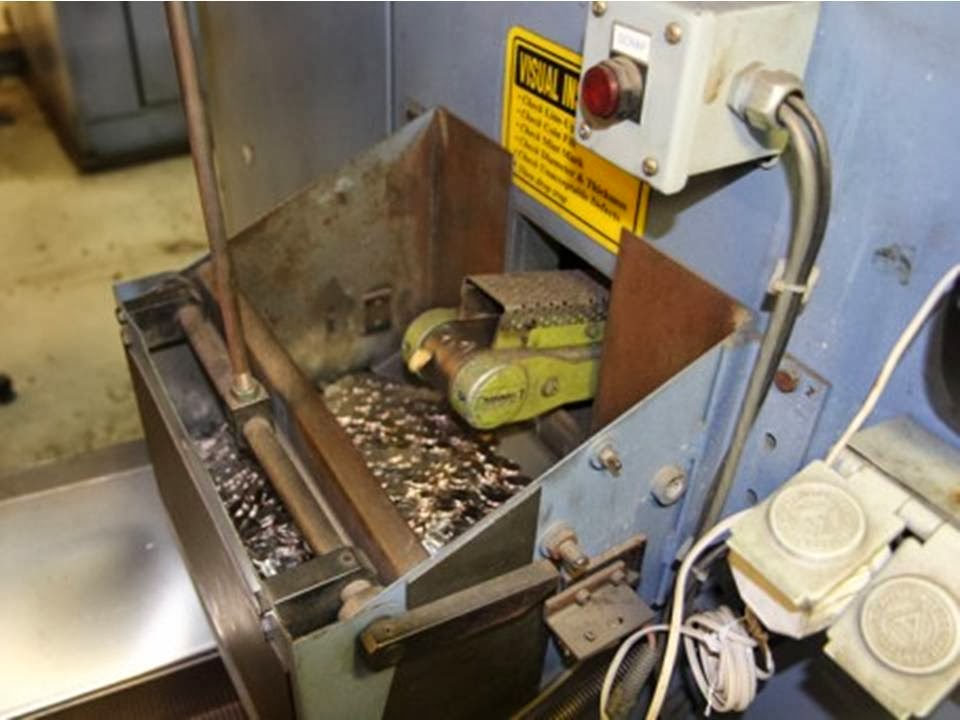
If the coin has an error, all of them in the box are condemned. They later go through waffler machines to destroy the designs. This photo shows some resulting waffles.
http://www.coinnews.net/2013/10/07/photo-walkthrough-of-u-s-mint-at-philadelphia/


http://www.usmint.gov/kids/coinnews/mintingProcess/step_6.cfm


 http://blogs.telegraph.co.uk/news/jamesdelingpole/100146037/why-money-printing-is-like-global-warming/


Bureau of Engraving and Printing

U.S. D
Department of the Treasury
Pictured below: Shrink-wrapped packages of one dollar notes.


The Production Process


How Money Is Made Today


http://blog.mysanantonio.com/the-arena/2012/02/read-it-and-weep/

The BEP is one of the largest currency printing operations in the world with facilities in Washington, D.C. and Fort Worth, Texas.  Current BEP currency production is quite different from its beginnings in 1862, which consisted of a handful of people separating notes with a hand-cranked machine in the basement of the Treasury building.    Technology has brought the BEP a long way to a state-of-the-art manufacturing operation producing U.S. paper currency. The production of this currency is not an easy or simple task, but one that involves highly trained and skilled craftspeople, specialized equipment, and a combination of traditional old world printing techniques merged with sophisticated, cutting edge technology.  Overall, there are numerous, distinctive steps required in the production process.

With the introduction of redesigned currency, subtle background colors were added to the redesigned notes to make them more secure and difficult to counterfeit.  The new design was applied to the $5, $10, $20, $50, and $100 notes.  Circulation of the new series began during the fall of 2003, with the introduction of the redesigned $20 note.  It continued with the $50 note in 2004, the $10 note in 2006, and the $5 note in 2008.  The new $100 note is currently in production with a release date to be announced as soon as possible.  Redesign of the $1 and $2 notes is not planned.

The redesigned notes retain the same size as previous notes and use similar portraits and historical images to maintain an American look and feel.  Security features maintained in the enhanced Federal Reserve Notes include a portrait watermark visible when held up to a light, two numeric watermarks on the $5s, an enhanced security thread that glows under an ultraviolet light, micro printing, improved color shifting ink that changes color when the note is tilted, and on the newly redesigned $100 notes, a 3-D security ribbon and enhanced, raised printing.  While the percentage of counterfeit notes in circulation remains small, advances in technology have brought forth an increase in computer generated counterfeit notes.  United States paper currency is redesigned as a way to protect your hard earned money by staying ahead of advancing technologies and tech-savvy counterfeiters.

Paper and Ink

The paper and ink used in the production of U.S. paper currency is as distinct as its design.  The paper comes to the BEP in brown paper-wrapped loads of 20,000 sheets (2 pallets of 10,000 sheets).  Each of these sheets is tracked by the BEP as it passes through the production process.   And, the total inventory of 20,000 sheets is continually reconciled to make sure each sheet is accounted for.  Currency paper is specifically made for the BEP by Crane Paper Company.  The ordinary paper that consumers use throughout their everyday life such as newspapers, books, cereal boxes, etc, is primarily made of wood pulp; however, United States currency paper is composed of 75% cotton and 25% linen.  This is what gives United States currency its distinct look and feel.  For denominations of $5 and above, the security thread, and watermark are already built into the paper when it is received.

All bills, regardless of denomination, utilize green ink on the backs.  Faces, on the other hand, use black ink, color-shifting ink in the lower right hand corner for the $10 denominations and higher, and metallic ink for the freedom icons on redesigned $10, $20, and $50 bills.   The $100 note's "bell in the inkwell" freedom icon uses color-shifting ink.  These and the other inks appearing on U.S. currency are specially formulated and blended by the BEP.  Inks headed for BEP presses also undergo continual quality testing.

Designing


FILE - This Sept. 24, 2013 file photo shows a sheet of uncut $100 bills as they make their way through the printing process at the Bureau of Engraving and Printing Western Currency Facility in Fort Worth, Texas. The new $100 bill, with a number of an array of high-tech features designed to thwart counterfeiters, will finally get its coming out party on Tuesday, partial government shutdown or not. The Federal Reserve, which has not been affected by the shutdown, will have armored trucks rolling from its regional banks around the country headed to banks, savings and loans and other financial institutions with the new C-notes. (AP Photo/LM Otero, File)
http://finance.yahoo.com/photos/100-bills-start-circulating-tuesday-photo-183245630.html


Bank note designers at the BEP develop the overall look, layout, and artistic details of U.S. paper currency.  The design of money starts with ideas and rough sketches.  Many concepts are drawn and considered before the Secretary of the Treasury approves the final design.

When redesigning a note, designers do not start with a blank slate.  They know, for example, that a $10 note will feature Alexander Hamilton on the face and the Treasury building on the back.  But which portrait of Hamilton, and which view of the Treasury building — that is for the designers to propose, in collaboration with the engravers.

Currency is designed with a purpose.  When redesigning a note, designers strive to convey a dignified image that reflects the strength of the American economy; retain familiar characteristics that identify a note as American currency; incorporate the latest anti-counterfeiting features; and consider how details such as outlines, tone, and shading will "translate" when engraved and printed on an intaglio press.

Traditionally, bank note designers utilized classical tools like the pencil, pen and ink, or paint brush to take their visions from concept to the final model ready for the engravers.  Today, the modern designer has the command of a wide array of tools including cutting edge digital technology.  While the processes have evolved over time, one important tradition remains in the steadfast production of America's paper currency — a designer's and engraver's exquisite attention to craft and detail.

Offset Printing Operations


A worker "jogs" a stack of uncut currency by blowing air in between each sheet. This ensures that the money is cut with exactness. (Photo by Andrew Evans, National Geographic Traveler)
http://digitalnomad.nationalgeographic.com/2013/03/22/fort-worth-where-the-moneys-at/


With the introduction of the redesigned $20s in 2003, subtle background colors were added to the currency to enhance the security.  For these denominations, offset printing is the first printing that occurs on the "blank" paper.

Offset Plates


We believe this is an offset printer used in the printing of money – it’s very hard to track down some of these operations!  The Printer seems to be operating in a production run of $20 Dollar notes with plates in place.
Felicity B. Noodleman
http://thegenesisblock.com/at-this-rate-the-last-new-btc-will-be-issued-55-years-ahead-of-schedule/


Before the subtle background colors of today's redesigned currency can be printed, the imagery must be transferred onto offset printing plates. That is the job of photoengravers.   The photoengraver receives the master design from the bank note designer and "steps" (duplicates) the images over a plate layout.  Then using a high-resolution film recorder, each color separation is imaged onto a sheet of sensitive film in negative form.  A thin sheet of steel, coated with a light-sensitive polymer, is exposed to ultraviolet light while covered by the film negative which contains the imagery.  The areas on the film that allow light to pass onto the plate are transferred or exposed. The unexposed areas around the images are washed away with water and soft scrubbing brushes.  This process is called "burning a plate."

To achieve the offset color scheme on a redesigned $20 face, for example, the photoengraver burns two plates. One plate contains the background pattern that will be printed in green and peach. The second plate contains the images that will be printed in blue — an eagle and the words TWENTY USA. The photoengraver takes great care to make sure the images are perfectly aligned on both plates, or else the images will not line up properly when printed on the bills.  In addition to the alignment check, each individual note on a plate is thoroughly inspected.  The slightest blemish from a dust particle or piece of lint may affect the print quality.  If it does, then a new plate is manufactured.

Offset Printing

The background colors are printed by the BEP's Simultan presses, which are state-of-the-art, high-speed, sheet-fed rotary offset presses.  These presses are over 50 feet long and weigh over 70 tons.  They are specifically designed to print security offset designs on currency paper.  Using dry offset plates, ink from the plate is transferred to an offset blanket.  The blank sheet of paper passes in-between the face and back blankets and simultaneously prints the complete image on the paper. The press has eight print units, four on the face and four on the back, with two comprehensive computer control consoles.  Many of the press settings can be controlled from these consoles and their status displayed on the computer screens. The press is capable of printing 10,000 sheets per hour; approximately every 500 impressions, the pressmen will pull a sheet and carefully examine it to ensure that all the colors are remaining consistent.

These sheets are stored for 72 hours to dry before going on to the next section, Intaglio printing.  Drying occurs in Work-In-Process security cages, otherwise known as WIP cages. On average, the BEP inventories 2,000,000 sheets (or 100 loads) between Offset Printing Operations and the Back Intaglio printing operation.

Intaglio Printing Operations

Intaglio, pronounced in-tal-ee-oh, comes from an Italian word which means to cut, carve, or engrave, indicating that intaglio images are engraved into the surface of a plate.  In the intaglio printing process, ink is applied to a plate so that it remains only in the engraved areas.  Paper is then laid atop the plate, and the two are pressed together under great pressure.  As a result, the ink from the recessed areas is pulled onto paper, creating a finished image.  Intaglio printing is used for the portraits, vignettes, scrollwork, numerals, and lettering that are unique to each denomination.

Engraving


Engraving the “Die Master” used in making the printing plates to print money.
http://maybach300c.blogspot.com/2012/08/money-modern-marvels.html


Engravers engrave a web of fine lines and grooves into steel dies, transforming designer's models into three-dimensional engravings.  Sharp tools (commonly called gravers) and acids are used to cut the fine lines, dots and dashes that uniquely describe the subject the engraver is creating.  Additionally, the engraver must cut the image in reverse to how it will actually print on a highly polished steel die. 

Engravers do not work on a whole note design at once.  They engrave separate parts of the design on separate dies.  Some engravers specialize in portraits and vignettes, others in letters and script. 

Siderography

In simplest terms, siderography is the means by which multiple images of the hand-engraved die are transferred to a printing plate.

In siderography, individually engraved elements such as the portrait, border, counters and text are first combined like pieces of a jigsaw puzzle to form one complete face (or back) of a note using a transfer press.  Siderographers use this machine to exert as much as 4 tons per square inch to transfer the original work to a master die. Later, individual plastic molds are made from the master die and are assembled into one plate containing 32 exact duplicates of the master die.  Plate makers will then process this plate to create the metal printing plates that go on the presses. 

After the dies are assembled and reproduced on plates, engravers cut in additional items, such as series, quadrant numbers, and signatures into the plates using a pantograph machine.  A pantograph copies the die engraving onto the plate.  As one part of the machine traces the original engraving another part engraves the image onto the new plate.

The original engraved dies are stored and can be used again and again as needed. For example, the Lincoln portrait on the Series 1928 $5 note was originally engraved in 1869, but can still be used to make new dies today.

Intaglio Plate Making


Test Plate
http://www.coinbooks.org/club_nbs_esylum_v14n10.html

The plastic master plates are transferred from siderography and used by plate makers to create hundreds of identical printing plates — identical because they are all based on the same master.

Electroplating is how this is done. The plastic master, which is called the "basso", is sprayed with silver nitrate to act as an electrical conductor. The plate is then placed into a tank filled with a nickel salt solution, and an electric current is generated. Nickel ions leave the solution and deposit themselves on the electrically charged surface of the master. After about 22 hours, a nickel plate, called an "alto" has literally grown. The alto is separated from the plastic master, trimmed, and inspected by the engravers.  The plate contains the mirror image of the master in all its intricate detail and is an exact replica of the original engraved die.

Even this plate is not the one destined for the printing press. The actual printing plate comes from a later generation of plates grown from the alto plates in the electroplating baths. That final printing plate is coated with a thin layer of chrome to make it hard and slick. It contains the Intaglio image in recessed grooves only 2/1000 (0.002) of an inch deep — but that is deep enough to hold ink for intaglio printing.

From engraver to plate maker, every BEP employee involved in the steps leading to the Intaglio press checks and re-checks his or her work for any sort of flaw, no matter how small. Dents, seams, or scratches in the die or plate will hold ink and create a printed mark, so defects during these preparatory stages would leave a blemish on every note printed from that die or plate.

Even the thickness of the printing plate is scrutinized; the margin of error is only +/- 0.0003 (three ten-thousandths) of an inch. That's 1/10th the thickness of a human hair.

Back Intaglio Printing


The inked-up nickel plates on an intaglio printer.
http://www.esquire.com/features/benjamin-hundred-dollar-bill-0913-6


High-speed, sheet-fed rotary I-10 Intaglio printing presses are used to print the green engraving on the back of U.S. currency.  Blank currency sheets for the $1s and $2s or the offset printed sheets for redesigned currency are fed into these presses and printed at a rate of 10,000 sheets per hour.   Four 32-subject engraved plates are mounted on the press then covered with ink.  A wiper removes the excess ink from the surface of the plate, leaving ink in the recessed image area of the plate.  Paper is applied directly to the plate and under tremendous pressure (approximately 20,000 lbs. per sq. inch), the paper is forced into the engraved plate, thereby removing the ink and printing the image. 

Currently, the BEP is implementing the latest Intaglio printing technology called the Super Orlof Intaglio (SOI) press which could help the BEP move from a 32-subject production process to a 50-subject environment.  Like the I-10 presses in Back Intaglio, the two SOI presses print 10,000 sheets per hour and are currently printing 32-subject sheets but have only three printing plates instead of four.  The presses are 40 feet long, 11.5 feet wide and 13.75 feet high, weighing in at just a mere 50 tons.  Most astounding is that these mammoth presses have 185,634 total parts!  In the future, because of their 50-subject printing capability, they could increase productivity by 56% by increasing the notes printed per hour from 320,000 to 500,000!  These presses also have a better integrated inspection system with ten times the resolution of the older presses, have the capability of printing one additional color, and have a more precise ink control which helps save costs by reducing ink usage.  The SOIs also feature a four-pile delivery system versus a two-pile on the older I-10's which reduces spoilage by having less weight (pressure) on the bottom sheets of each pile.

Jogger

Sheets that were printed from the Back Intaglio process require 72 hours to dry and cure. During this drying process, the sheets bond and stick together. Therefore the sheets must be separated and neatly jogged before they can be printed on the Face Intaglio press.  To do this the BEP employs automated joggers shaped much like the letter "C."  Support personnel retrieve the load and place it into the jogger.  The load is turned on its side and, through the combination of vibration and forced air, the sheets are separated.  The process takes approximately 10 minutes.  Once jogged, the load is moved to the designated Face Intaglio press.

To recap, the subtle background colors are printed first using Offset print technology, then the green engraving on the back is printed second using the Intaglio printing process. The third printing operation is the Face Intaglio printing process.

Face Intaglio Printing


...awaiting serial numbers and seals. After this it's money...
http://www.esquire.com/features/benjamin-hundred-dollar-bill-0913-6

Once again, Intaglio presses like those used to print the Back Intaglio engraving are used to print the faces of the bills.   While the same printing process applies, one difference is how the ink is applied to the engraving.  Special cut-out ink rollers transfer the different inks to a specific portion of the engraving, thus allowing three distinct colors to be printed on the face of the note; the black for the border, portrait engraving, and signatures of the Secretary of the Treasury, and the Treasurer of the United States; the color-shifting ink in the lower right hand corner for the $10 denominations and higher; and the metallic ink for the freedom icons on redesigned $10, $20, and $50 bills or color shifting ink on the redesigned $100 notes' freedom icons.  Bills printed in Fort Worth, Texas, will also have a small "FW" printed in black ink.  The loads of these freshly printed sheets will still require 72 hours to dry and cure before they can continue to the next operation.

Mechanical Examination

Throughout the printing processes, minor printing imperfections may have occurred, either through printing or the handling process.  In order to ensure only the highest quality sheets proceed to the numbering operation, the face and back of the sheets are thoroughly examined using state-of-the-art computer technology. 

UOCIS

The Upgraded Offline Currency Inspection System, otherwise known as UOCIS, integrates computers, cameras, and sophisticated software to completely analyze an untrimmed printed sheet.  By examining untrimmed sheets, the BEP is better able to monitor color registration and ink density. 


Nota-Sav

Nota-Sav is the BEP's examining equipment utilized to examine the $1 product line.  Since those bills have neither a security thread nor a watermark, Nota-Sav does not need the technical sophistication of UOCIS.   Using electronic examination "eyes" to inspect the sheets, these inspection systems provide the automated means to process the $1 bills as they move forward on a transport. 


COPE

COPE-Pak presses in this section utilize the letter press printing process which is the third and final type of printing utilized by the BEP for paper currency.  The acronym COPE-Pak stands for Currency Overprinting Processing Equipment and Packaging.  These presses were custom designed specifically for the BEP and are the most automated equipment of their kind in the world.  This press takes a 16-subject printed and examined sheet of currency and adds the two serial numbers, the black universal Federal Reserve seal, the green Department of the Treasury seal, and the corresponding Federal Reserve identification numbers.

Serial numbers on the redesigned currency differ slightly from those on the old currency.  The new serial numbers consist of two prefix letters, eight numerals, and a one-letter suffix.  The first letter of the prefix designates the series (for example, Series 1996 is designated by the letter A, and Series 1999 is designated by the letter B).  The second letter of the prefix designates the Federal Reserve Bank to which the note was issued. The serial numbers are overprinted in sequential order and remain in order until the 16-subject sheets are cut.  

In addition, a universal Federal Reserve seal replaces individual seals for each Federal Reserve Bank.  On the other hand, $1 and $2 dollar notes have not been redesigned.  Those notes still maintain the specific black Federal Reserve Bank seal.  Finally, the green Department of the Treasury seal is printed on all denominations.

The Treasury seal, the universal Federal Reserve seal, and the 12 Federal Bank seals are manufactured by a team of sculpture engravers, siderographers, and plate makers.  Traditionally, the Treasury and Federal Reserve Bank seals were hand engraved and duplicated in a similar fashion as the currency master die.  The siderographer used the transfer press to make many copies from one master die.  Today, technologies are emerging in this process and seals are now being manufactured using an Electronic Discharge Machine (EDM).  In this process, the engraver has prepared a digital file and sends it to a plate maker where the images are "burned" into the individual surface pieces using an electric current.  When each piece is completed, the engraver inspects it prior to releasing it for print production. 

As sheets pass through the COPE process, they are inspected by the COPE Vision Inspection System (CVIS).  Prior to this new technology, an examiner would hand-inspect approximately 6% of the finished work whereas today we are inspecting 100%.  CVIS alerts the COPE pressmen to sheets whose COPE attributes are potentially not up to standardized specifications, checking them using grayscale technology for position of the COPE features and correctness of the serial numbers, prefixes, suffixes, and bank numbers.  CVIS uses red lighting, providing optimal lighting for inspection by minimizing the Intaglio printing so that the equipment can key in on only the sheets' COPE attributes.  The computer compares the scan of the sheets against a database containing captured images and numeric qualities and, in 200 milliseconds, decides whether or not to accept or reject the sheet.  That's faster than the blink of a human eye (300-400 milliseconds)!  If a sheet is identified as being defective by the system, the pressmen will then pull the sheet in order to make a final determination as to whether or not it should continue through the process.  If they agree that in fact the sheet is defective, they will replace it with a star sheet.  In design, the star sheets containing 16 star notes are exactly like the sheets they replace; however, a "star" appears after the serial number in place of the suffix letter on each of the notes.

The currency sheets are then gathered into piles of 100.  The pile continues down the transport where it passes through two sharp guillotine cutters.  The first cut is made horizontally, leaving the notes in pairs.  The second cut is made vertically, and for the first time you see individual notes.  A denomination paper band is wrapped around each group of 100 notes to form a strap.  Ten straps of 100 notes (totaling 1,000 notes) are then banded together and machine counted before they are shrink-wrapped, forming a bundle.  Four shrink-wrapped bundles are collated together, identified with a bar code label then shrink-wrapped again to create a brick of 4,000 notes. 

In 2008, an ergonomic piece of equipment called a palletizer was added to each one of the COPE-Pak presses to eliminate the repetitive, rotating motion performed by an employee as they placed the bricks onto skids. As the bricks enter the palletizer, they are flipped over and the barcodes are scanned for information.  An air-powered arm picks up the bricks from the transport using vacuum suction in addition to forks and grippers.  The palletizer will stack 160 bricks to complete two skids and then place a lid over them.  It will then advance the full skids forward, where they will be secured and stored for the next operation.  As full skids are advanced and removed, the palletizer will continue grabbing empty skids, placing them into position to start receiving more bricks.

COPE 
Total Number of Bills 
100 bills equal 1 strap 
 100 bills
10 straps equal 1 bundle
 1,000 bills
 4 bundles equal 1 brick 
 4,000 bills

Packaging Operations and Federal Reserve Vault

Packaging Operations is the fifth and final stage of the currency production process before the currency is shipped to our customers, the Federal Reserve Banks.  Bricks of currency are printed with a unique numbering sequence.  Packaging operations aligns the completed skids from COPE operations and collates four bricks of currency into the proper numbering sequence for the final packaging.

Scanners read the COPE-Pak bar code on the first bundle of the first of four bricks that will become a "Cash-Pack."  The four bricks are then shrink-wrapped using a heavy, color-coded shrink film, which is then heated to about 450°F, to create a Cash-Pack, consisting of four 4,000 note bricks or 16,000 notes.  The machine then verifies proper sequencing, applies a new label, and then stacks 40 of them on a skid. Like COPE operations, Packaging operations also utilizes an ergonomic palletizer.  This palletizer is also powered by air and uses vacuum suction in addition to forks and grippers to pick up each Cash-Pack.  It can store up to two full skids (80 Cash-Packs) at a time before they must be removed from the machine by a forklift.

This equipment eliminates the physical labor and rotating motion previously performed by an employee who would stack the completed Cash-Packs onto the pallets.  Prior to ergonomic improvements such as the palletizer, the employee was required to stack approximately 7,400 pounds (or 3.7 tons) per day.  This tool greatly helps to prevent injuries and employee fatigue and has proven to be another successful ergonomic improvement at the Bureau of Engraving and Printing.

The completed loads will be transferred and securely stored in the Federal Reserve Vault for future pickup and distribution by the Federal Reserve Bank.

 Federal Reserve Vault and Packaging
 Total Number of Bills
 4 bricks (from COPE) equal 1 cash-pack 
 16,000 bills
 40 cash-packs equal 1 skid
 640,000 bills*

*The value of the skid is 640,000 multiplied by the denomination contained, (e.g. 640,000 bills x $10 = $6,400,000.


http://www.moneyfactory.gov/uscurrency/theproductionprocess.html


In conclusion; there are several good documentaries on the production of money available. PBS's "Nova" program entitled "Secrets of making Money"  The other we recommend is by the History Channel program entitled "The Making of US Currency", if you would like to learn more. National Geographic has also produced "America's Money Vault", which is a very fine documentary.  Another area of interest is the hobby of currency collecting known as "Numismatics"; this is an avocation which covers a wide encyclopedia of information regarding everything ever made or printed by the US Mint.

Our interests in covering this subject are to varied to be mentioned.  This subject is highly stimulating!  We will mention the "Trillion Dollar Deficit" and try to imagine that much money! This has been Felicity writing for the "Noodleman Group".  


Obama, Biden and Bernanke
Wait until Americans realize that most states in the US are broke and radical changes are immediately ahead at these levels never mind what the federal government has to eventually cut. If it is any consolation, Europe is in the same fix. Is it any surprise then that nations want to commandeer pensions, as Argentina, Hungry and France have already done.
http://www.anunews.net/blog/?cat=805


Tell your friends and associates about us! 
It's easy!  Just copy and paste me into your email!


* “The Noodleman Group” is pleased to announce that we are now carrying a link to the “USA Today” news site.We installed the “widget/gadget” August 20, and it will be carried as a regular feature on our site.Now you can read“Noodleman” and then check in to “USA Today” for all the up to date News, Weather, Sports and more!Just scroll all the way down to the bottom of our site and hit the “USA Today” hyperlinks.Enjoy!

Friday, December 6, 2013

HOLIDAY SHOPPING 19,395


HOLIDAY
SHOPPING


http://goburley.com/tag/fun


*  Special thanks to "Google Images", "about.com",
"yesaterdayontuesday.com",  "CNNMoney", "theshoppingmama.com"
and "US News &World Report"


BLOG  POST
by Felicity Blaze Noodleman
Los Angeles, CA
12. 6.13


Now that the holiday shopping season is in full swing, now that we have past “Black Friday”, “Small Business Saturday” and “Cyber Monday” and now that we have fewer than 20 days left to shop, the question still lingers!  What, or should we say, how is the best way to shop?  There are so many outlets where we are able to make those holiday purchases.  All of these options have their advantages and disadvantages (as if), some save us time while others save us money and some offer convenience over other considerations! 

Is the real truth about shopping more psychological than about where we are shopping?  Somehow we just have the need to do our shopping and won’t stop until that urge has been satisfied or until we have run out of money, or even worse, until we have reached our credit limit?  Even then some find money from other sources so that they may continue to feed the need to shop! 


Shopping has ramped up as consumers rush to get last minute gifts, but experts say the late push may not be enough to save holiday retail sales. A weekend wedged in right before Christmas seemed like the perfect gift for procrastinators who wait until the 23rd hour for holiday shopping, or shoppers who wait for one last big sale.
Estimates for the final shopping weekend aren't out yet, but there's evidence that more shoppers were coming into stores as the holidays drew near.
NEW YORK (CNNMoney)


Holiday shopping on Thanksgiving?!?
Very cleverly, retailers began preparing you to begin your holiday shopping back in October before Halloween.  Each year seems earlier and earlier!  They are trying to expand their holiday profits by stretching those shopping days as much as they are possibly able! 
http://www.whatnowtoons.com/wnt_archives.asp?M=46


Some sources or avenues for shopping fulfill that need for instant gratification while others content us with the knowledge of what really is important is the thought behind giving, especially when it’s long distance!  This article will attempt to unravel, de-cloak and expose the best method for accomplishing our holiday shopping in the modern day!

Ask yourself a simple question: is it possible to beat “Walmart” or “Sam’s Club” in the world of retail merchandising?  I mean, they just about have everything imaginable – and at the best ever prices.  Stores like these are volume discounters.  They operate on a very small profit margin per item and earn their very huge income by brute force – VOLUME!


5 Tips for Simplifying Holiday Shopping

Holiday shopping is no simple feat. Many savvy shoppers literally shop for the holidays year round. Even if you aren’t buying stocking stuffers in August, there are some ways you can make the process easier.

1. Make a List and Check it Twice. Keep your shopping list organized with by following the Who-What-Where-When-Why Rule.
Who do you have to buy for?
What are you going to get?
Where are you getting it?
When are you giving / shipping?
Why? Well, because giving is fun!
If you want a modern version of the shopping list, check out the app store for apps like Gift It.

2. Give a Signature Gift. RealSimple.com says “Don’t be afraid to give repeat gifts.” If your family enjoys apersonalized calendar one year, repeat the gift again next year. We receive a Swarovski ornament every year from my dad and stepmom and while it’s obviously not a surprise, it is one of my favorite things to open every Christmas.

3. Have a Go-To Gift. Real Simple also suggests picking one gift for those outside your immediate family that has special meaning to you. For example, we’re sending several members of our family German chocolate. It represents where we are this year and we know they’ll all enjoy it.

4. Donate to a Charity. There is inevitably at least one person on your list who is difficult to shop for because it seems like he literally has everything. Honor him with a donation to a charity with special meaning.

5. Shop Strategically. We love online shopping and it is the best tool for streamlining holiday shopping, but we still have to hit brick and mortar stores for many things. Plan your trips strategically. In other words, don’t hit the local shopping mall the weekend before Christmas. We may have learned that from experience.

http://theshoppingmama.com/2012/12/how-to-simplify-holiday-shopping-giveaway/

The merchants next in line for our discussion today are the more traditional retail merchants who seem to have been around forever and a day.  These are the stores who fill our shopping malls from coast to coast.  These are the stores that put the fun into shopping!  These merchants have gone all out here during the holidays to accommodate our shopping – well for the lack of a better term, LUST, and these stores in many ways are one of the fundamental rights of the holidays!  Am I wrong?

Now to let’s ask ourselves another question; what if all  the holiday decorations were suddenly removed from our cities because these retailers were no longer around for us?  I like to think of these optional stores, in the world of shopping, as the “higher end” specialty stores.  They include all stores both large and small and all have a purpose for the discriminating shopper!  They charm us with their displays inside and out, they sooth our minds with their beautiful music and the fragrances which fill our sense of smell put us in another world. 


http://www.ibtimes.com/are-gift-cards-right-you-holiday-season-1484902


Soon, we have forgotten our troubles and cares.  We have reached that special state of Nirvana which is by now pumping us full of Endorphins stimulating those special receptors in our brain and will keep us coming back again and again until we are old and gray.  Sounds like the best drug in the world!


Snatch a Price Match

1.  Did you know that many bricks and mortar stores like Target, Best Buy and Staples will match online giant Amazon’s lowest prices? Here’s how it works: Find the items you are interested in at the bricks and mortar store, then using your smartphone, search for the same item online. If you you can find a lower price at Amazon– the other store will match it!
Tip: Skip the regular check out line and head to customer service for this and have your online “deal” ready to show. The store will look it up and if it’s legit, they’ll match the price!

2. Ask and You May Receive: Even if you are shopping a a small brick and mortar store and they don’t have any policy posted about matching an online store’s prices. Last weekend my husband hit our local cycling shop for some gloves. He was able to pull up the same cycling gloves at an online retailer for $7 LESS. He simply asked the salesperson if they price matched and he got the glove he wanted for the discounted price. Plus no shipping!
Tip: Don’t be embarrassed to bring up a lower price you found online. You are also helping the store make a sale– even if they give it to you for the lower price.

3. Picture It: Use your smartphone to snap photos of potential gifts as you see them. When you’re ready to do your holiday shopping, you’ll have made yourself a visual shopping list and slashed your stress!
Tip: Try and get the PRICE of the item in the photo as well, so you can score the best deals.

4. “Like” It for Special Steals and Deals: Use your smartphone or tablet to get on Facebook and “Like” the  stores where you might buy  consider holiday presents. Many businesses will give you a coupon or special offer just for throwing them a like. Plus, you’ll get notified via your Facebook feed when they are having sales and discounts.
Tip: If you decide you aren’t interested in the store, you can always “unlike” it later to stop receiving their feed.

5. Get “App”-y:  You can also utilize your smartphone  to download shopping apps. Do an online search of “best shopping apps” to see what’s out there and choose the best app(s) for you! Tip: You might also consider seeing if your favorite stores have their own free money-saving apps. It’s another great way to save some cash!

http://yesterdayontuesday.com/2013/11/5-tips-stress-free-holiday-shopping/


Some of us shop just so we will be able to let our special Santa what we want and where the best place to get it is.  We don’t want to be disappointed because we didn’t make a list he could check twice.  As the old saying goes, “a closed mouth is never satisfied” and we never want to hear “well you should have said something”.   I think this is an area where most of us don’t have a problem!

Next; we come to the new kids in the world of shopping.  The retailers on line!  The “Cyber Stores”.  Many of us shop on line because the Internet never closes.  No matter how we are dressed, weather in sickness or health, sometimes even in our sleep we sit down to the computer with our favorite beverage and snack to see who has the best prices, services and locations.  Cyber Stores are the catalogs of our day and age.   We may even buy on line and have our merchandise shipped any place in the world.  All without even setting foot out our front door!

There are a few things to keep in mind when going on line to shop.  First; any savings which might be found are quickly devoured by the expenses incurred by shipping your purchase over the Internet.  If you are shopping for someone out of your local area however; this could turn into a huge plus and save a tremendous amount of time both in shopping, packaging and sending your gift. Secondly remember; items bought on line are more difficult to exchange and return. Finally; sizing and fitting are almost impossible when shopping for clothing on line, so be careful!


http://nlga-homesforhounds.blogspot.com/


One area we haven’t covered yet are those of us who just don’t shop at all.  We are the “card stuffers”.  We don’t want to disappoint with a gift that won’t meet the expectations of our loved ones.  We pick a nice card and enclose it with the always appreciated denominations of “dead Presidents” or a gift card from a store we feel will be well received by those whom we wish to bestow our kindness upon. 

This was my Grandmothers philosophy and I know she didn’t give it a second thought.  She knew her gift would be long remembered and appreciated, even after she had passed on.  If you really want to hear your loved ones squeal with glee make sure that card is filled with both cash and several gift cards for food and merchandise! 


https://www.mint.com/blog/credit/the-secret-to-protecting-your-credit-scores-during-the-holiday-shopping-season-1113


"US News & World Report"


10 New Tech Tools That Make 
Holiday Shopping Easier
From apps to new websites, these tools will help you stay organized, find deals and save money
By KIMBERLY PALMER
December 3, 2013 


Shopular's app displayed on an iPhone.


The crush of holiday spending can do major damage to budgets, despite our best efforts to stay in control. Fortunately for shoppers, entrepreneurs and app developers have embraced the challenge of the season and put their talents to good use: Building tools to help us survive with our sanity, and our bank accounts, intact.
Here are 10 new tools that make it easier to defend your time and cash from the onslaught of the season:
1. Sift
If you're stuck on what to purchase for your significant other, parent or any other loved ones in your life, this free app can help. It tells you what products are flying off the shelves at your favorite stores (out of a database of more than 3,000 stores) and also sorts through your custom preferences – and email newsletters you receive from retailers – to help make suggestions. TechCrunch recently reported that the service received $2 million from supporters to further expand.

"Sift helps consumers save tons of time and money by aggregating all of their shopping and deal-related emails. ... Instead of having to weed through countless emails, users can simply flick through Sift and find items and deals that are tailored to their specific shopping fingerprint," says Saurin Shah, co-founder and CEO at Sift. He adds that Sift users access five times the number of deals as people who just look through emails.  Best for: Anyone in need of last-minute gift ideas.
2. Gyft
Since gift cards will be a popular gift this year, with the National Retail Federation reporting that the average shopper will spend a record $163 on them, you're going to need a way to keep track of the ones you receive. (Forgetting to use a gift card is as wasteful as losing cash, after all.) The app Gyft lets you uploadyour gift cards, purchase new ones, track balances and spend them. "You never have to worry about losing a card again," says Vinny Lingham, CEO of Gyft. He adds that Gyft's loyalty program also allows users to earn points that can be redeemed for purchases.  Best for: People with wallets full of gift cards or plans to hand out gift cards at the holidays.

3. Shopular
Already used by more than 1 million shoppers, this app lets you know about current deals while you're shopping. In other words, you can walk into the shopping mall, and get alerts about discounts from your favorite nearby stores. In that way, it's similar to other apps, like SaleSorter, that pull information on current markdowns at shoppers' favorite stores and push those alerts to consumers.
"Shopular will give its users an edge this holiday season, [since] they'll carry the best in-store coupons and circulars all on one device … As you reach the mall, Shopular will automatically alert you to hot deals at your favorite stores," says Shopular CEO Navneet Loiwal. Coupons can be redeemed by just showing your smartphone at the register, he adds.  Best for: People who love to browse shops in-person but don't want to miss out on any special deals.
4. ShopGenius
Like the online tool PriceBlink, ShopGenius works as a browser add-on that lets shoppers check prices elsewhere on their item without leaving the website that they're on. The tool lets you know if you'll be able to find a lower price for the same product elsewhere. "ShopGenius [enables consumers] to view the best available price for products they are shopping for online without leaving the e-commerce page they are on. This has special
benefit for time-pressed, budget-conscious shoppers who have limited time to search for the best available product price," says Dave Compton, CEO of ShopGenius.  Best for: Shoppers who make a significant portion of their purchases online.
5. Boxed
If you like the appeal of bulk discounts at Costco or Sam's Club, but don't live near a warehouse club or don't want to bother visiting (and paying to join) one, then Boxed is for you. Shoppers can make purchases via the app, schedule deliveries and get free delivery for orders more than $75.
"Boxed brings the savings of warehouse club right to your mobile device," says Chieh Huang, CEO and founder of Boxed. Membership is free, and Huang says most orders arrive within a day or two. (Free overnight shipping is available in select cities.) "Save your free time for things that really matter," he adds.
Best for: People who love buying in bulk but dislike the hassle of visiting warehouse clubs.

6. EasilyDo
Many of us feel overwhelmed at some point during the holidays, and the app EasilyDo promises to act as a "personal assistant" to help us stay organized and save time. It deletes deal-related emails that have expired from your inbox, files e-receipts for you, tracks packages and lets you know when they've arrived, and makes it easy to store your lists in one place. It also sends you bad weather alerts.
"Most of us shop, travel and party more during the holidays than at any other time of the year," says Mikael Berner, founder and CEO of EasilyDo. "Jumping between airports, malls and holiday get-togethers can make it difficult to stay on top of our lives, and it's easy to miss something we care about when we are overwhelmed by all the little things we haven't had time to do. EasilyDo proactively makes sure you never miss anything."  Best for: Stressed out, overbooked holiday shoppers.
7. Slice
Slice, an app and online tool, collects your purchase and shipping information from online purchases to make it easy to track your shipments, make returns, get price drop alerts (and then assistance on requesting a partial refund from retailers to make up the difference) and alerts if one of your purchases is recalled. Since it collects this information automatically, you don't need to manually enter anything.
"Slice helps consumers effortlessly make sure they get the best price on the gifts they buy with price protection. Most shoppers don't think to monitor the price of an item after they've bought it, but Slice does it for them by automatically alerting them when the price drops, so they can recoup the difference and make sure they get the best deal," explains Thad Hwang, vice president of product for Slice.
Best for: Time-pressed online shoppers who want to make sure they always get the best deal.
8. Scoutfit or Shop It To Me
Instead of constantly monitoring items for potential price drops, ScoutFit tracks items on your shopping list for you and then sends you alerts when they go on sale. The browser button lets users track specific items, and then sends an email when it reaches the shopper's desired price or goes on sale. It also offers recommendations for related or similar products. Shop It To Me, an email service as well as a new app, lets you know when your favorite clothing brands go on sale in your size.
"Scoutfit saves all gift lists in one place, and if things go as expected, Scouters will receive emails every day with price drop alerts so that they can buy all of the items they're shopping for at a sale price. Scoutfit will also provide up-to-date coupon codes while you shop," says Scoutfit's co-founder and vice president of marketing, Lainie Herrera.
Charlie Graham, CEO of Shop It To Me, says his service "makes shopping all of the December sales easy. Put in your favorite brands of clothing, shoes, handbags and accessories, and your individual sizes. We'll track the store sales for you and let you know as soon as your favorite brands go on sale in your size." He adds that using the service also saves you time because you don't have to sort through retailer emails or aimlessly surf the web for sales.  Best for: Online window shoppers who don't want to buy until they know they're getting the lowest price.
9. FoolProofme
Foolproofme.com, an educational website, offers an impulse buying test that calculates just how much impulse purchases can cost a person over his or her lifetime. For example, it reports that shoppers spend $11 or more on average each time they use a credit card instead of cash for small purchases, which can add up to $55,000 over one's lifetime. It also offers videos, articles and tips for staying in control of purchases. "The test allows you to see which areas can get you into trouble," says FoolProof spokesman Remar Sutton. "It gets you to slow down and have some fun online learning about how you waste money," he adds.
Best for: Overspenders who need some help with tamping down their costs during the holidays.
10. PopNod
The website PopNod has collaborated with more than 350 retailers and organizations, including Zappos and Best Buy, to make it possible for shoppers to get cash back on their purchases, and then donate a portion to charity. Shoppers can shop at their favorite stores online from within the site and then choose to donate between 0 to 100 percent of their cashback. "PopNod does all the hard work so shoppers can save money and help their favorite causes," says Stephanie David, co-founder of PopNod.
Best for: Online shoppers who want to feel good about giving back while taking care of their shopping list.  Best for: Online shoppers who want to feel good about giving back while taking care of their shopping list.
"US News & World Report"

Now we come to that special breed of shopper – the men in our lives.  Every man I’ve ever met has boldly proclaimed that they do not like stores or shopping and hate it!  I’ve discovered that is just not true – it just depends upon the kind of store where they feel comfortable and what they like to shop.  These are the hardware’s and sporting stores like “Home Depot” and “Big 5” for example.  

Men love tools and they love anything related to camping and the great outdoors.  It is these establishments that you will actually see the man in your life revert to his childhood and his eyes will light up and twinkle.  Trust me, if you give your man anything  that says “Craftsman” or “Coleman” your job will be done and he will talk about for some time to come – he will even use them instead of stuffing them in the closet!  They also live any kind of technical gadget as well.  Oh yes; and they respond very well to food!

Don’t let your shopping lead to "Blue Monday" or a "Blue January" as you think of all the debt you have piled up over the holidays!  With just 19 days left for holiday shopping it might be wise to plan a budget for the remainder of your gift giving purchases and remember to spend wisely!  Oh; and don't forget to give to your favorite charity's.  Your gift will mean so much for so many who have so little.  I'm Felicity with the Noodleman Group helping you shop and hoping you don't drop!


http://politicalhumor.about.com/od/politicalcartoons/ig/Christmas-Cartoons/Spirit-of-the-Season.htm


Tell your friends and associates about us! 
It's easy!  Just copy and paste me into your email!


* “The Noodleman Group” is pleased to announce that we are now carrying a link to the “USA Today” news site.We installed the “widget/gadget” August 20, and it will be carried as a regular feature on our site.Now you can read“Noodleman” and then check in to “USA Today” for all the up to date News, Weather, Sports and more!Just scroll all the way down to the bottom of our site and hit the “USA Today” hyperlinks.Enjoy!